Conversation and Web Event with the River Otter Ecology Project – List of Links and Resources from the Presentation
ROEP and VIDEO are linked HERE

LINKS
Water
The importance of water and my statistics are in part from the “Our World in Data: Water Use and Stress” website. Also the characteristics and biochemistry, the “specialness of water” largely comes from this peer-reviewed article, Frenkel-Pinter M, Rajaei V, Glass JB, Hud NV, Williams LD. Water and Life: The Medium is the Message. J Mol Evol. 2021 Feb;89(1-2):2-11. doi: 10.1007/s00239-020-09978-6. Epub 2021 Jan 11. PMID: 33427903; PMCID: PMC7884305.
The PDF of the Federal Water Pollution Control Act, 1948 (“Clean Water Act,” 1972) with Amendments up to 2018 and the PDF of the Safe Drinking Water Act, 1974, which “established protective drinking water standards for more than 90 contaminants, including drinking water regulations issued since the 1996 amendments to the Safe Drinking Water Act that strengthen public health protection.” Here is the weblink to the summary of the legislation.
The Environmental Protection Agency Website – Very useful for definitions and terms for what a clean watershed looks like, how watershed health is measured (e.g., The Healthy Watershed Index), and how some waters are vulnerable (e.g., Watershed Vulnerability Index)
Pollutants
PFAS chemicals, which is an umbrella term for PFOA, PFOS and other synthetica, industrial “forever chemicals,” and stand for “per- and polyfluoroalkyl substances.” A description of the differences and their health consequences can be found at the American Cancer Society, linked here to PFOA, PFOS, and Related PFAS Chemicals.
Some states are at greater PFAS contamination risk than others, the Environmental Working Group, is a nonprofit research and advocacy organization, published a report in 2020 stating that an “estimated more than 200 million Americans are served by water systems where two of the most studied PFAS chemicals (umbrella category of these synethic chemicals): Perfluorooctanoic acid (PFOA, pronounced: per-FLOOR-oh OCK-tan-OH-ick acid) and perfluorooctane sulfonate(PFOS) – were present in drinking water at a concentration of 1 part per trillion, or ppt, or higher.
Here is their map of PFAS contamination in the U.S. by state.
Additionally, here is an interactive map developed in support of veterans, a population disproportionately affected by exposure (full disclosure: developed by a law firm that helps veterans navigate disability benefits) that shows contamination risks across U.S. military bases.
Plastics. As of the time of this post, global annual plastic production is approximately 450 million metric tons. Our World in Data, provides a breakdown. NOTE: I use this source a lot. It’s an organization that, through the collaborative efforts of researchers at the University of Oxford and the Global Change Data Lab, provides an up-to-date statistical record of meaningful statistics (like Pew Research).
Microplastics: The long legacy left behind by plastic pollution. UN Environment Programme
The life of microplastic: how fragments move through plants, insects, animals – and you. Phoebe Weston and Tess McClure, July 28, 2025, The Guardian
Pharmaceuticals
Bean, T. G., Chadwick, E. A., Herrero‐Villar, M., Mateo, R., Naidoo, V., & Rattner, B. A. (2024). Do pharmaceuticals in the environment pose a risk to wildlife? Environmental Toxicology and Chemistry, 43(3), 595-610.
Fabbri, E., & Franzellitti, S. (2016). Human pharmaceuticals in the marine environment: focus on exposure and biological effects in animal species. Environmental toxicology and chemistry, 35(4), 799-812.
Norman, S. A., Lambourn, D. M., Huggins, J. L., Gaydos, J. K., Dubpernell, S., Berta, S., … & Scott, A. (2021, January). Antibiotic resistance of bacteria in two marine mammal species, harbor seals and harbor porpoises, living in an urban marine ecosystem, the Salish Sea, Washington State, USA. In Oceans (Vol. 2, No. 1, pp. 86-104). MDPI.
Ojemaye, C. Y., & Petrik, L. (2019). Pharmaceuticals in the marine environment: a review. Environmental Reviews, 27(2), 151-165.
Ecological Terms
The role of particular flora or fauna in ecology that are considered “Keystone,” “Indicator,” “Priority,” “Flagship, or “Umbrella” species are explained through the World Wildlife Fund (WWF, 1961) or World Wide Fund for Nature (name change in 1986) on their Global Species Programe webpage.
The late, great Dr. Robert (Bob) Paine’s 1966 Paper, “Food Web Complexity and Species Diversity” is available HERE, as well as a great biography about him and his work on the keystone predator concept through starfish research, HERE. A memorial article, penned by Jim Estes and his colleagues, is linked here, titled “A keystone ecologist: Robert Treat Paine, 1933–2016.”
Similarly, the late, great Dr. James (Jim) A. Estes (Researchgate link), the sea otter ecologist and one of the first Otter Specialist Group members through the IUCN, was the first to apply the keystone concept to sea otters and their importance in the trophic equilibrium of kelp forests. The keystone sea otter manages the herbivory of the sea urchins, preventing urchin barrens, places where kelp was once abundant, but through urchin overgrazing, transform into barren deserts. Estes’ original 1974 paper, “Sea Otters: Their Role in Structuring Nearshore Communities,” can be found HERE.
There are also two wonderful tributes to his work, one through the Elakha Alliance (Oregon) and Sea Otter Savvy (California).
PBS Nature, has a great documentary, called “The Serengeti Rule,” a film that highlights the careers of these two accomplished ecologists, Bob Paine and Jim Estes. The film is linked HERE. Bob discusses his work in understanding the role of sea star predators in the ecological system, as well as Jim Estes and the importance of trophic cascades. The latter is illustrated through the collapse of some populations of Northern sea otters in Alaska. Their collapse was the result of a ripple effect triggered by decades of whaling. The removal of the gray whales caused a dramatic decline in a primary food source for mammal-eating killer whales, who took to eating harbor seals, then Stellar sea lions, and sea otters, such that by the end of the 1980s, there were places where sea otter populations had been wholly wiped out from orca predation. This resulted, then, in the collapse of the kelp forests around areas that were once flourishing.
Here is podcast episode #30 through Northwest Nature Matters, with Jim Estes
Ethical Guidelines for Wildlife Photography and Social Media
Practicing Ethical Wildlife Photography. Canadian Geographic
Ethical Guidelines for Wildlife Photography. League of International Photographers
What does it mean to be an ethical wildlife photographer? Sea Otter Savvy
Decision Tree Flow for Sharing or Promoting (i.e., Likes) Animal Photos on Social Media, Share Savvy
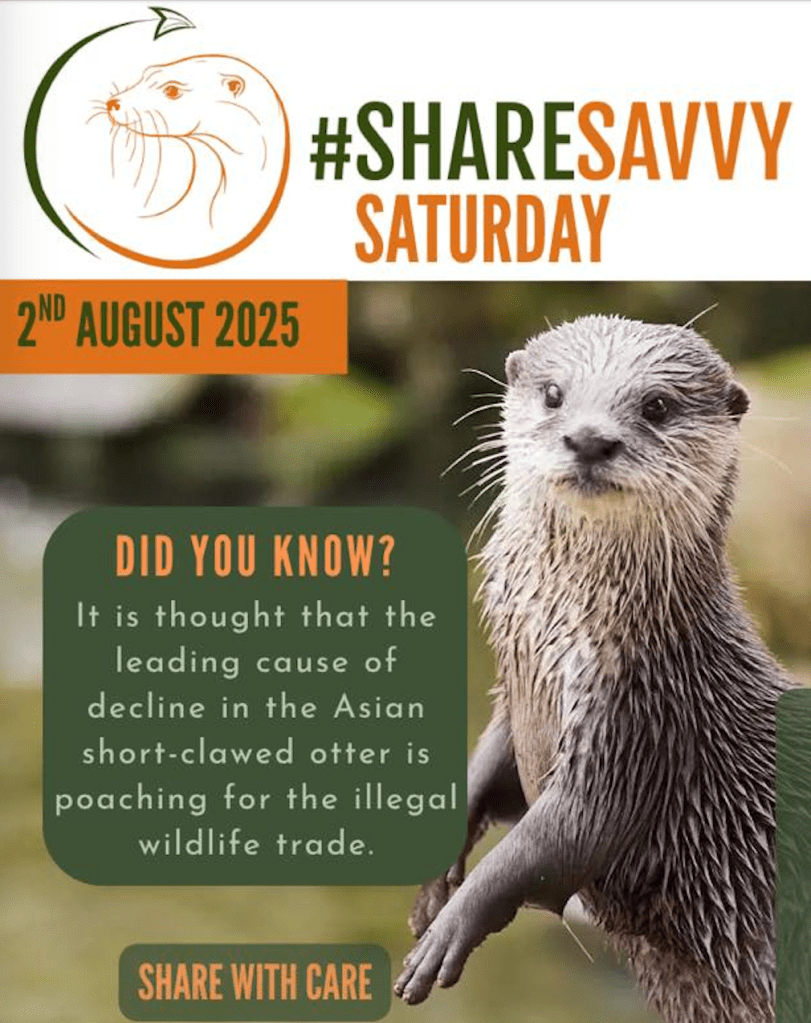
This advocacy organization offers suggestions for key considerations in identifying and promoting ethical animal photographs. The reason this matters is that there are a number of species, many endangered like the Asian small-clawed otter, that are targets of the illegal and exotic pet trades. Many of the videos and photos that are popular on Facebook, TikTok, and Instagram are not from reputable sources and are of wild animals that have been adopted as pets. This is an area of concern covered in my upcoming book, “Romp! A natural history of otters and why they matter.” Release date: May 2026.
Ethics of Wildlife Photography. The Wildlife Collective
“We Sure Could Use A Little Good News Today”…
Scientists find bioplastic that vanishes 80% even in extreme deep-sea conditions, Kaif Shaikh, July 23, 2025, Interesting Engineering
Scientists create ultra-repellent non-stick coating for safer cooking at home. Amir Khollam, July 25, 2025, Interesting Engineering.
Technology for the Greater Good. “Top 10 Conservation Technologies of 2025.” Matthew Miller, Cool Green Science: Stories of the Nature Conservancy.
How scientists are using facial-recognition AI to track humpback whales. Lauren Sommer. February, NPR
Happy Whale, Online Catalog for the Reporting and Identification of Humpback Whales
Natural Plant Extract Removes up to 90% of Microplastics from Water. SciTechDaily, June 18, 2025
In Praise of Predators! Harmony Farm Wildlife Density and Distribution Survey (Aug. – Oct. 2024)
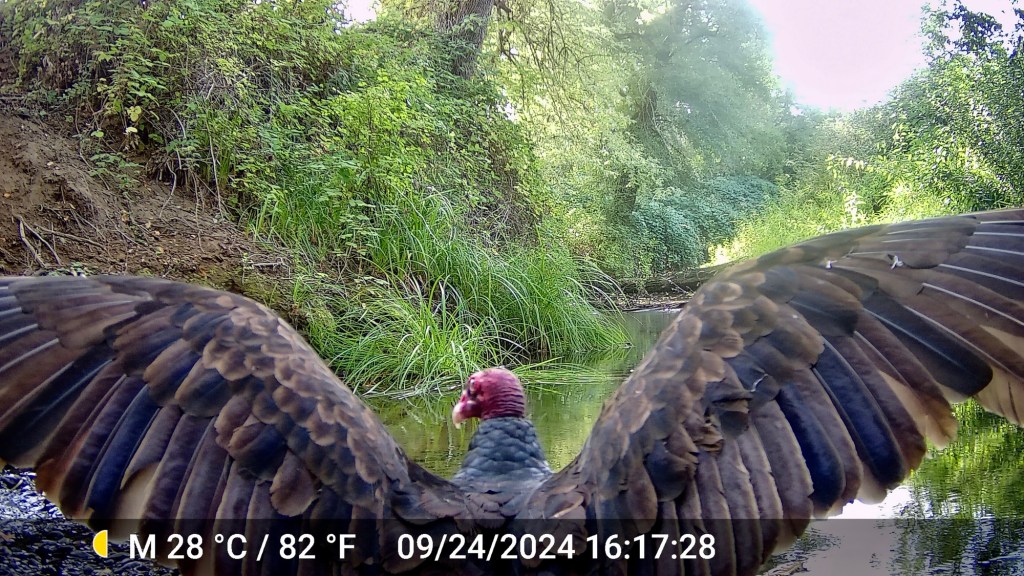
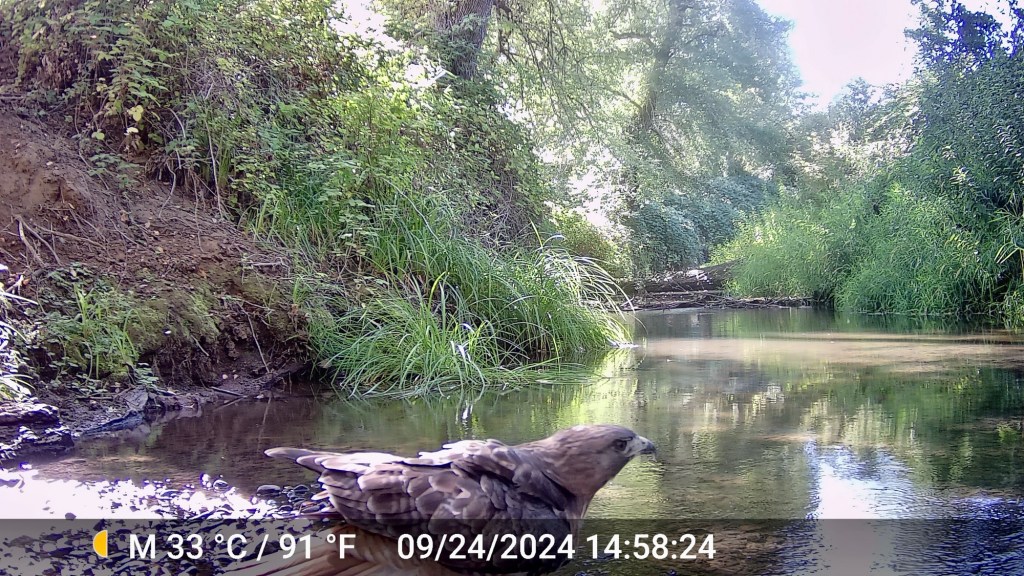
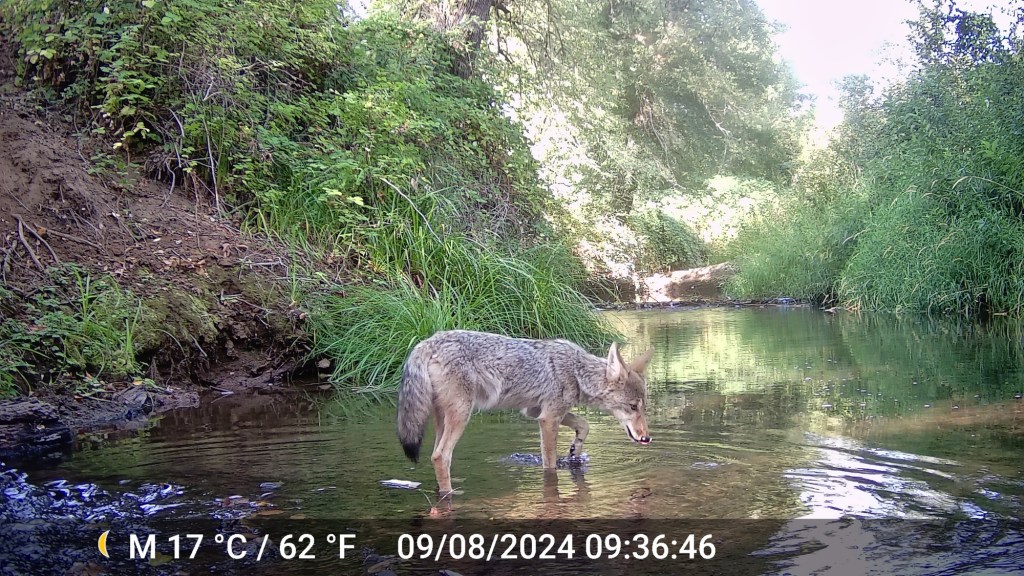
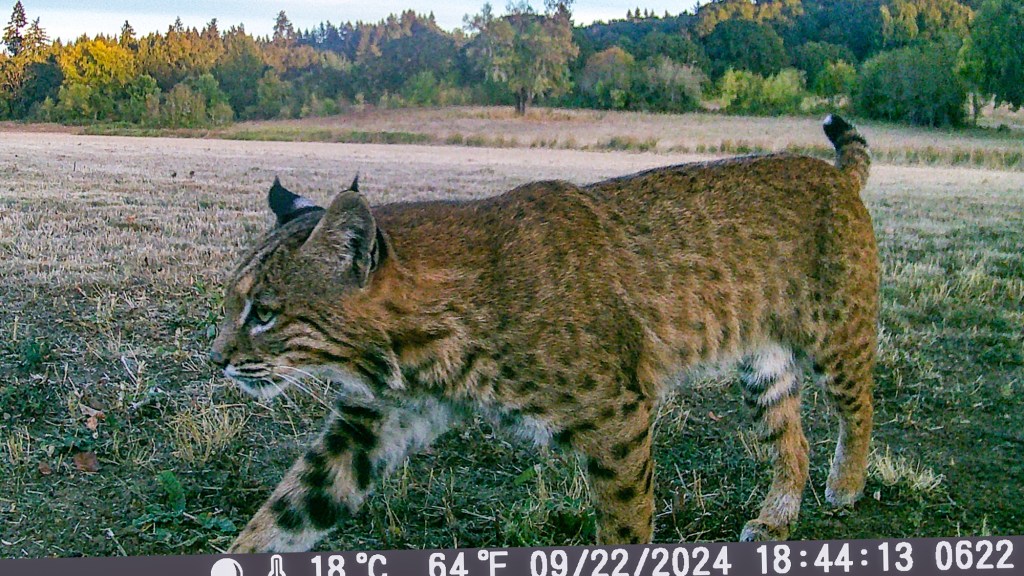
These photos are the “best of” wildlife trail cameras from our last density and distribution survey. Our cougar, black bear, and owls did not make it in this round. The cougar will likely be back over winter, as well as our elk. But the bear, such a fluke from last survey, has probably moved on.
Species Represented:
Turkey vulture (Cathartes aura)
Red tailed hawk – I think (Buteo Jamaicensis)
Coyote (Canis latrans)
Bobcat (Lynx rufous)
**Note:
A number of you have inquired about the hens (and rooster, sweet Giovani, see photo below) since I survey for predators and their conservation on our extended property. Well, rest assured, there is a camera at the aviary and I have not caught any interest from the raccoon or coyotes that make their way over to the camera. So I think the hops we planted last year and has now vined up the entirely of the 16 foot walls of hardware wire and over the top, has been a good deterrent.
All the wildlife photos are from unbaited, Bushnell Trail Cameras on Tom and my farm property, that overlaps with Baker Creek in McMinnville, Oregon.




…and our outside aviary with the hops, I need a new photo with the growth

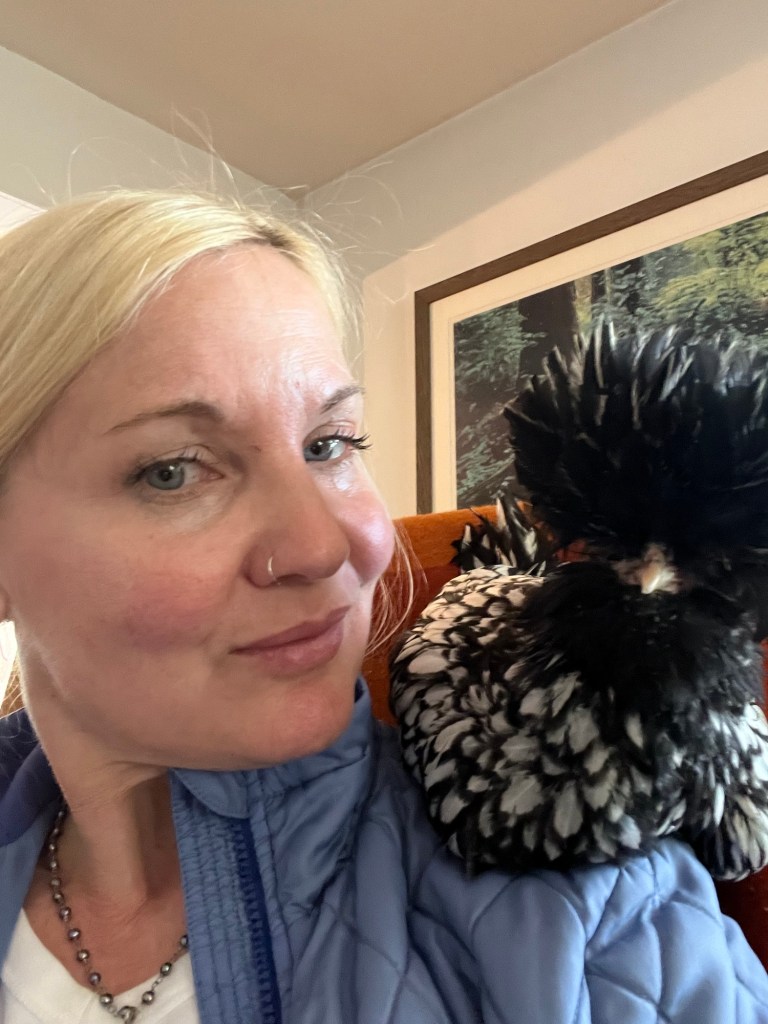
Unrelated photo of my boy, Giovani as a teenager. He is the sweetest, best Roo ever! #leaders_eat_last


Summer 2023 – Otterly Unusual Behavior

As I write this, my heart is breaking for Hawaii, for the people, their families, the importance and sacredness of the land in Polynesian culture – the 200 year old banyan tree in the middle of Lahaina that is no more. Just prior to the loss of life on Maui, the burning of historic downtown, and all important farmland, rainforest, and cane fields, Juneau, Alaska was underwater, with families losing homes to flooding. This summer has been tragic for a lot of people. It has also been a little weird.
For two months, sea otter 841 has focused public attention on Santa Cruz, California with her unusual surfboard snatching. Then earlier this week, three women in Montana during a leisurely float on the Jefferson River were attacked by a river otter, all resulting in hospitalizations. I gave an interview yesterday to a Daniel Ehrlick for the Daily Montanan to answer his questions and offer whatever insights I might have into what is going on with these behaviors. What isn’t in that article, is the fact that I think both instances are indirect examples of climate change as well, Here is the article interview with the Daily Montanan.
Congratulations Aspen Shirley! Media Spotlight on Whidbey Island River Otter Research and Student Researcher
Aspen joined the Whidbey Island Research Station (WIRS) as part of the Murdock Grant and the Pacific Research Institute in Science and Mathematics (PRISM) in May of 2021. There, she provided field support in collecting samples, data collection, entry, and logistics toward the project, “Seasonal Variability in Glucocorticoids Among Latrining River Otters (Lontra canadensis) of Whidbey Island, Washington,” a project to be presented at the PRISM Conference in November of 2021 and at the Western Psychological Association Conference in April of 2022. Congratulations Aspen!
Whidbey Island May Otter Data Submitted!
This May concluded with river otter specimen collection on Whidbey Island. Aspen Shirley, a post-Bacc Pacific University student joined me at the Whidbey Island Research Station (WIRS) for a week, thanks to the Pacific University Murdock Grant.

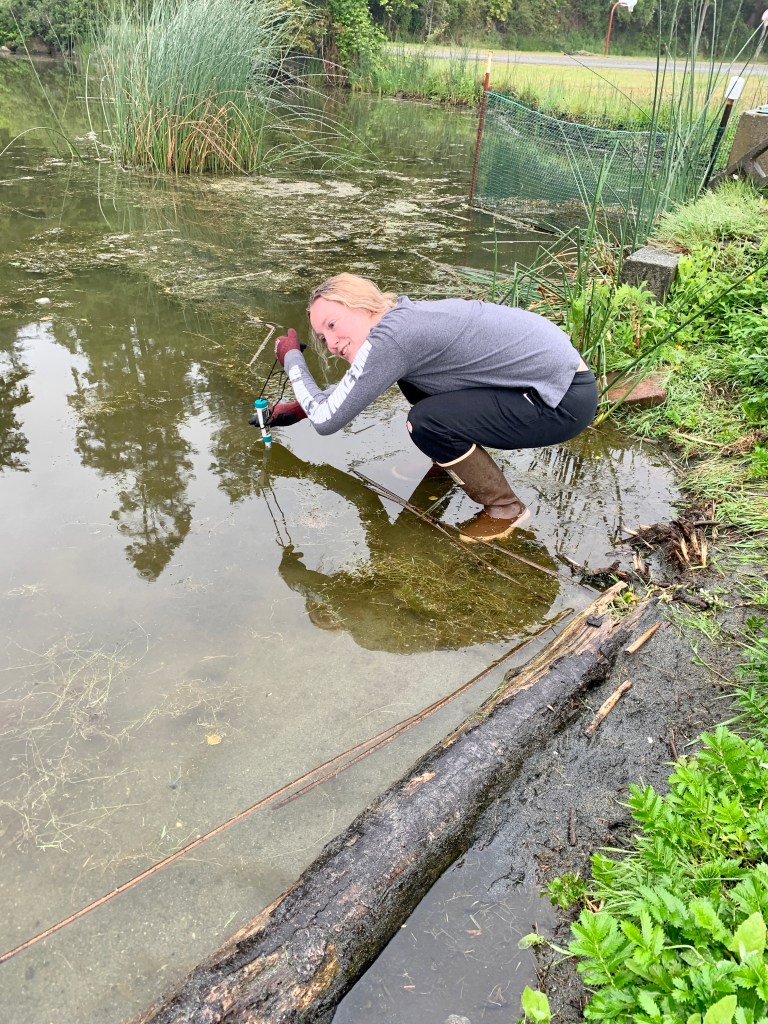

We collected marine foraging river otter fecal and jelly samples from around the Island, charted behavioral movements and presence and met up with wildlife photographer, Ty Kent at Port Townsend. Ty has had an excellent run of otter activity near Fort Warden at low tide this spring. Since our behavioral data collection and photographic luck on Whidbey was a lot of verbal exchanges like this one,
Heide (at Admiralty Bay), “The female just entered the culvert to Admirals Lake with a flat fish, if you go over there, perhaps you can capture her with your camera. I will stay at the Bay to see if she comes back.”
Then texts like this,
Aspen (at Admirals’ Lake), “Did the otter come back to you on the bayside? I videoed her for a minute before she disappeared in the bulrushes.”


Ty Kent graciously gave permission to share some our favorite, choice photographs from his otter encounters the week we were at Whidbey. You can find these and others (check out the mating otters on his Wildlife Photography page) at his website, Earthrootz Imagery. Also check out his other photos, they are remarkable. I’m especially partial to the romantically, stylized photos of his fiancé, Kelly.
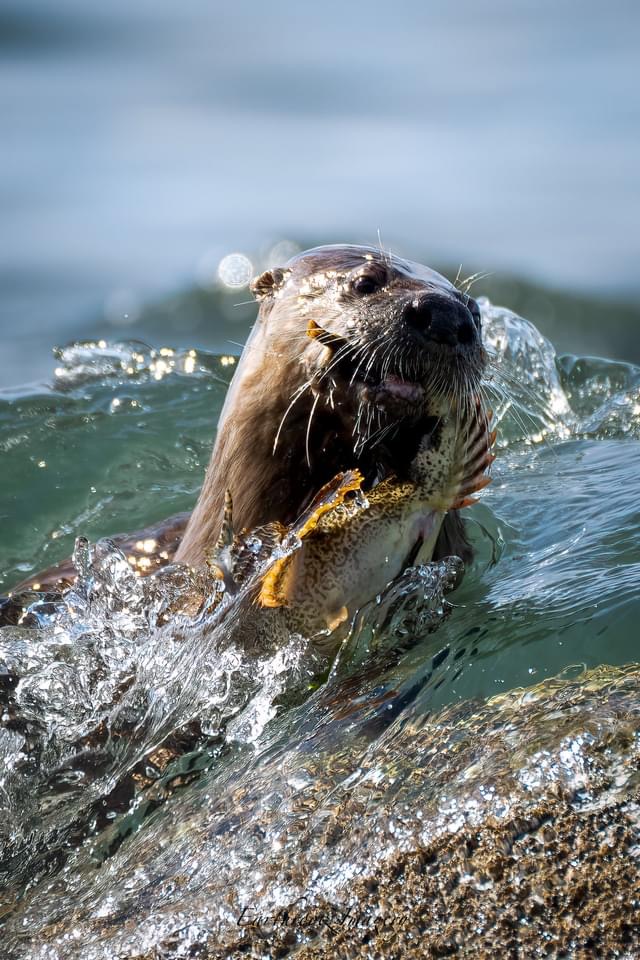
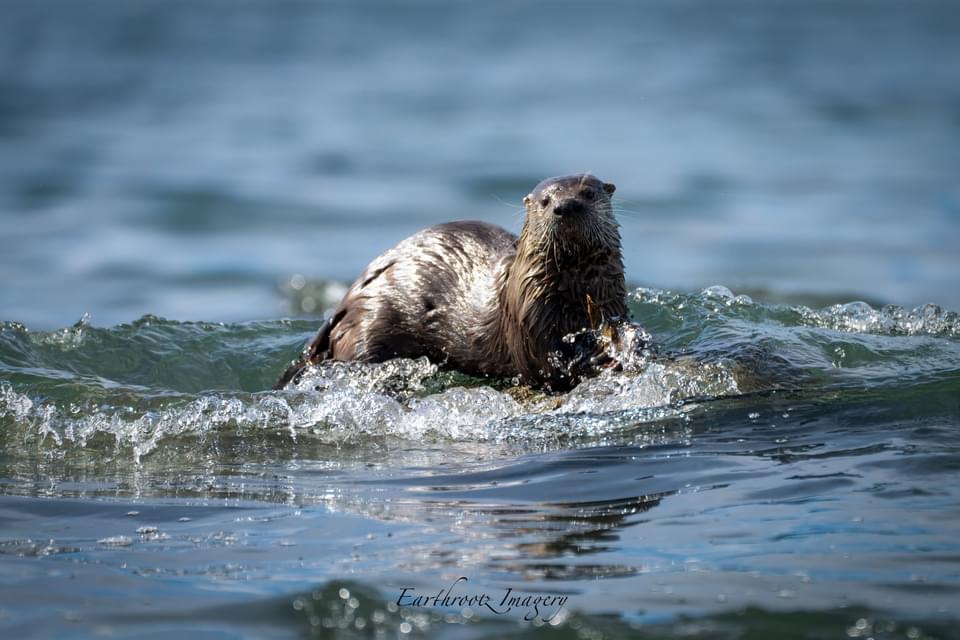
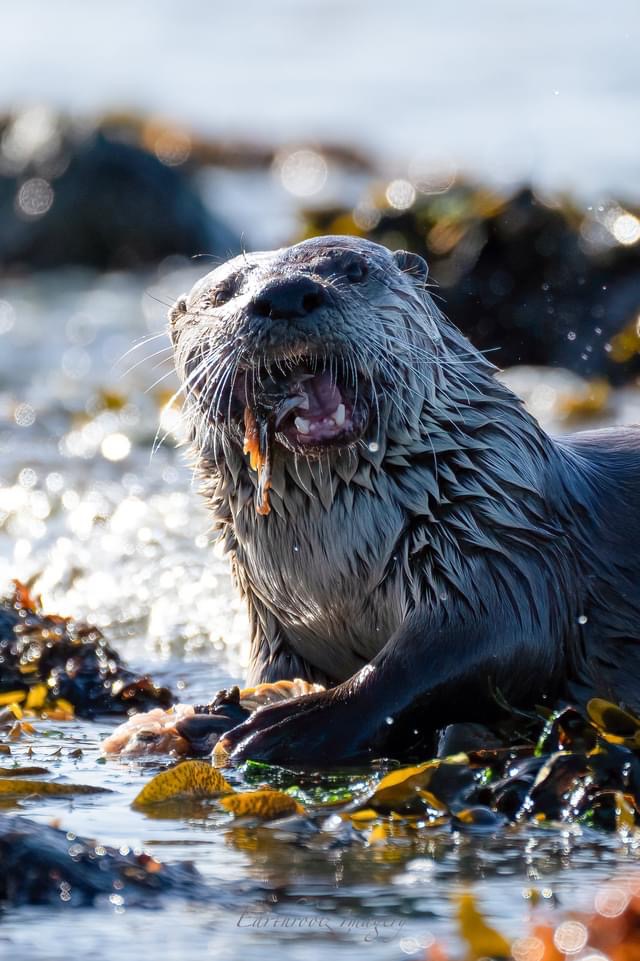

Ty described this series of photos as a romp of three, when a interloper tried to join them and was chased away. Likely this was a kin group with a female and her three female pups, the interloper is also a juvenile, likely a previously weaned male. You can really feel the speed with which the little male was dispatched in these photos.


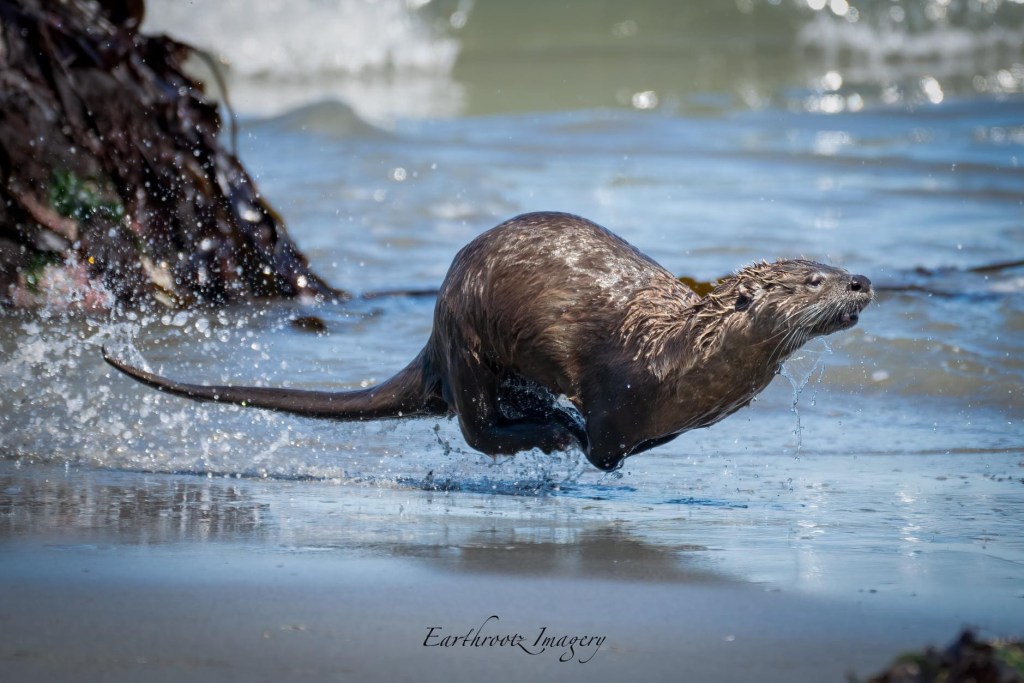
Thank you Ty for sharing your otter spot and the otter photos!
We were fortunate to also have a number of other wildlife encounters during our week-long stay at WIRS. A small group from the more than 3,000 black-tailed deer on Whidbey decided to forage among the poppies right in front of the cabin.

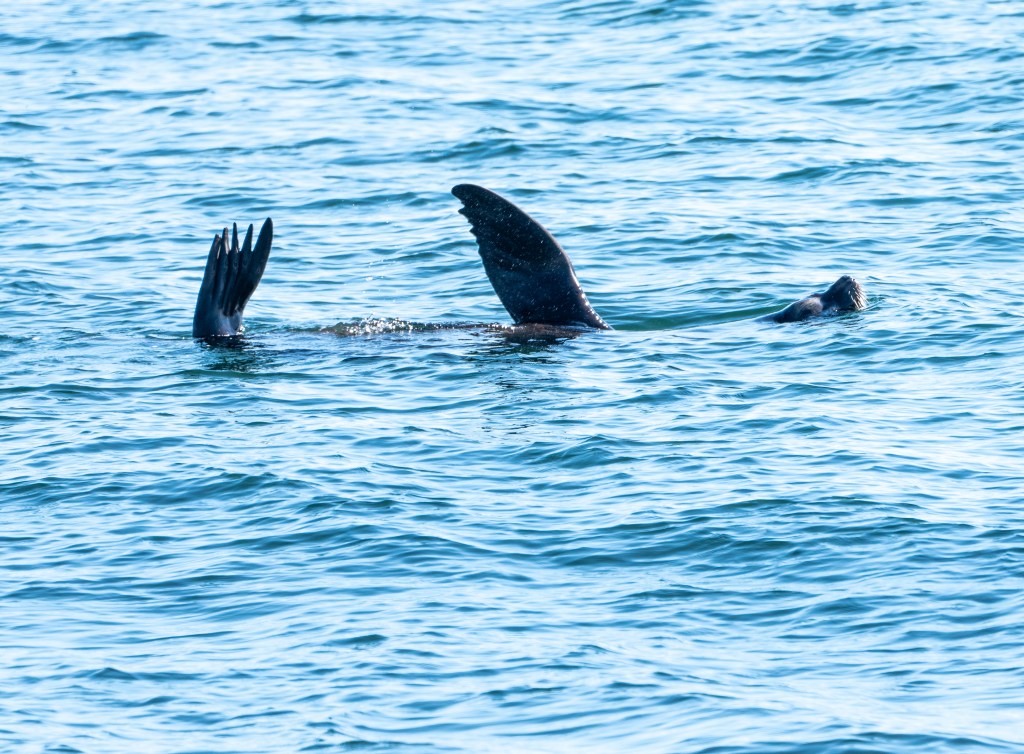
We also had a couple visits with California sea lions (one visit was concurrent with otters in the bay), harbor seals, harbor porpoise, short eared owls, northern harriers, bald eagles, whimbrels (Port Townsend), coyotes, and beaver.

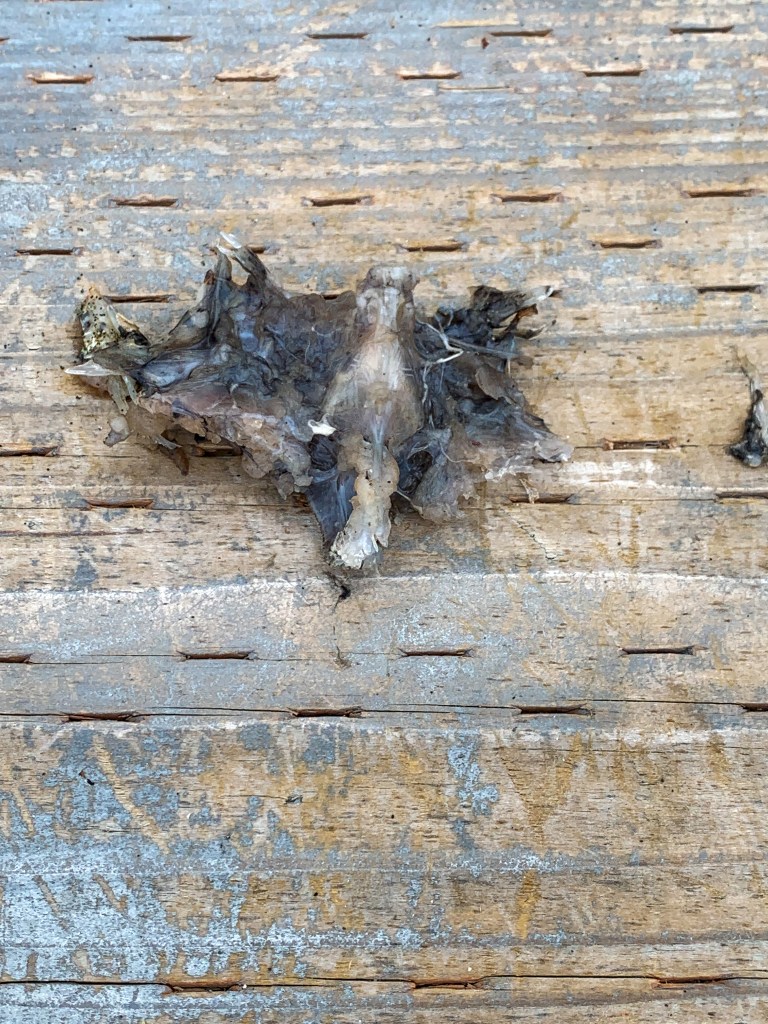
One morning we awoke to find an otter had hauled a staghorn sculpin on the stairs of WIRS and finished off everything but the spines and gills.


The infrared cameras also caught an interesting predatory encounter with a mallard duckling and a river otter.
Note in the video at about one minute, a hen and a drake are disturbed lakeside. They’re upset because below waterline, a river otter is attacking their brood of ducklings. They attempted to scare it away, but as you will see, they were unsuccessful. That little, yellow fluff hanging from the otter’s mouth is a duckling.
A total of 59 fecal specimens were submitted to the Oregon Zoo, Wildlife Endocrinology Lab the following week. Many of the samples were from earlier visits, citizen scientist collections, and represent 2 years of otter activity on Whidbey. The otter specimens are part of the second round of research involving the marine foraging river otters in Island County, as well as a comparative sample of rescued, captive North American River Otters from Oregon: Tilly, Buttercup (now deceased, but whose data will still be used for comparison), Flora and Hobson at the Oregon Zoo. We are interested in better understanding otter wellness as measured through glucocorticoids, specifically cortisol as well as steroid hormonal values across the two different populations. Steroid hormones, specifically testosterone, can be moderated by parasite load, diet, and contaminant exposure. These factors can further diminish the efficacy of healthy immune systems. This will be the first comparative study of captive and native North American River Otters, although both populations are wild born, from similar geographic regions, the Pacific northwest. Below are photos of Candace Scarlata, the Director of the Oregon Zoo Wildlife Endocrine Lab and where our data samples will be residing.
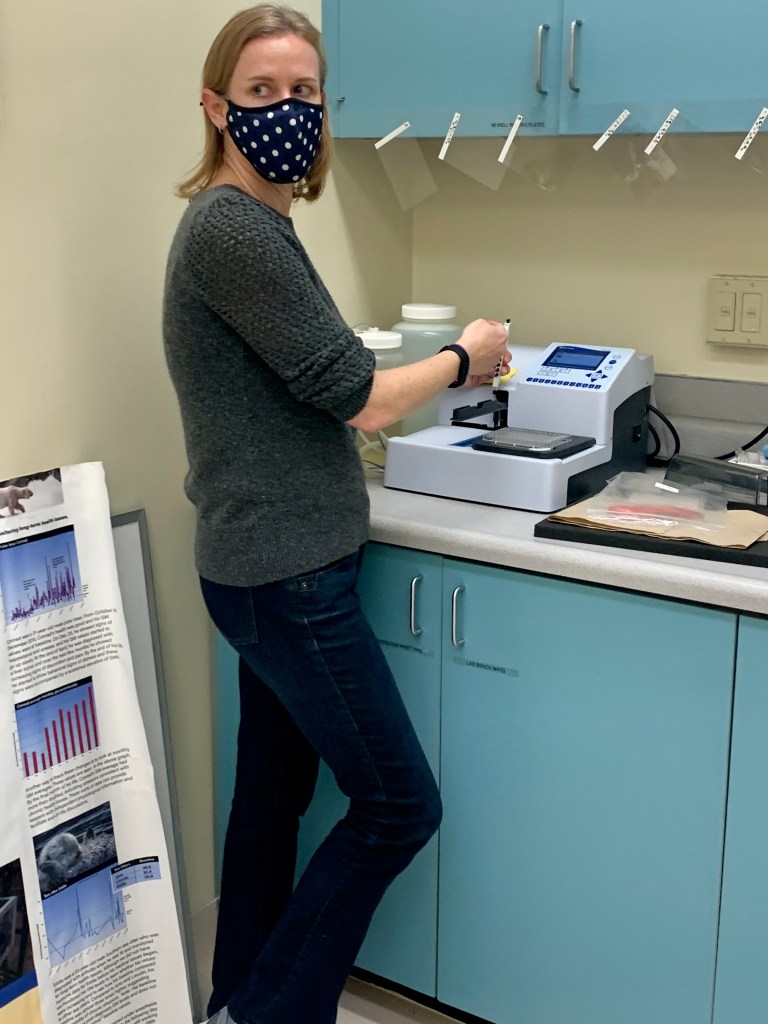


Standby, analyses are coming!
A Coyote Den in Otter Town
I am delighted to be back on Whidbey this month! Spring is the time in Behavioral Biology that you REALLY want to be in the field, especially if you study predator behavior. I received many accounts from the “Whidbey Otter Watchers” of otter sightings, matings, caterwauling (often mating), and marking, throughout the island. While finishing up the spring semester, I really struggled with FOMO (i.e., Fear of Missing Otters). Though, I was able to sneak back on Island in April during our brief spring break. By mid-May I look forward to Aspen Shirley, a student researcher, joining me here in Coupeville as well. We will be collecting fecal samples for a comparative study of native (Island County otters) and captive (Oregon Zoo) river otter steroid hormones. That information can provide valuable baseline data for health and wellness.
My first day back on Whidbey always involves an early rise to go check on infrared cameras, known latrine sites, and visiting with folks who have regular otter romps on their property. One spot that yielded quite interesting footage is of an area on Admiralty Bay, normally an ecotone (i.e., an ecological transitions between habitats) for river otter. Now it appears to serve as a run for coyote, potentially near a female den. I count at least 3 different coyotes in the video from March – April. Check out the coloration on the tails, as well as the extent of mange to ascertain different animals.
Coyotes breed in February and March and pups are born about 60 days later. An average coyote litter contains 4-5 pups, parturition is in early April to late May. So the footage is a compilation of coyote behavior from mating season to pupping season (last video clip is May 5).
River otter too, are breeding and pupping during late spring, 2-4 pups are born from March to May. Although otters are one of the 68 species within the order of Carnivora that delay implantation. This is obviously not a conscious or voluntary phenomenon, but depends more on their health and fat resources. Steroid hormones like progesterone, rely on fat for production, without adequate energy to produce hormones, implantation may be delayed, thus the fertilized egg does not attach to the uterine wall immediately after breeding. This means gestation can range from 60 days to 375 days. So river otters pup from spring through summer and wean from fall into winter. That said, I have received several reports (see below) of otter matings in Mutiny Bay, Admiral’s Lake, Ebey Landing and at Scatchet Head on the southend of Whidbey.
Otter Sightings
Tuesday May 4, 2021 at 20:35 – Ebey Landing, Jann Ledbetter
Jann Ledbetter shared this photograph of a marine foraging river otter, grabbing last catch, a staghorn sculpin, again near the culvert of Ebey Landing. The activity pattern of this otter and the one she captured on the 27th (likely the same animal) are indicative of their most active hours, around dawn and dusk. Though around the island, given it is breeding and pupping season, they are out and about at all hours. Crepuscular animals are nappers and thus can be seen throughout the day, with peak sightings at sunup and sundown. This otter, with her extraordinary metabolism, will ingest, digest, and “process” this meal all within one-hour post-consumption.
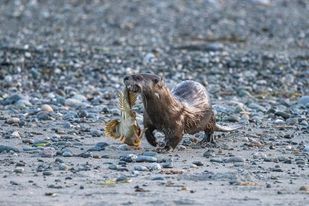
Tuesday, April 27, 2021 at 6:20 – Ebey Landing, Jann Ledbetter
Jann Ledbetter, one of Whidbey’s prolific wildlife photographers, shared this otter sighting on Instagram (included here with her permission). If you have not had the pleasure of perusing her Instagram and Facebook pages, take a minute to find her. They are full of exceptional photographs of harriers, owls, foxes, and of course our local Whidbey otters. She is outside, connecting with the Earth, and advocating for the wildlife with her beautiful images every day. Jann said she snapped this otter with her morning catch near the Ebey Landing culvert. Breakfast Special: Starry flounder. Thank you for sharing Jann!

Tuesday April 27, 2021 – Dugualla Lake, Oak Harbor, Ron Newberry wrote,
I went to Dugualla Lake, adjacent to our Dugualla Bay Preserve on North Whidbey. I noticed a ton of openings along the lake edge in the clay banks. Some holes were almost the size of a volleyball. There were many, many entrances to underground tunnels. Are those from river otters?
Part of what is even more fascinating about this is adult Western Toads were coming out of them at night. That lake is one of the few Western Toad breeding sites I know of on Whidbey Island. I have heard of toads using rodent burrows. I wondered how extensive this underground system was and whether this lake is such a good breeding side for toads partly because of the protection these tunnels provide from other predators like herons. I’m guessing a river otter might eat a toad, too, but toads are known to have toxins in their glands, so maybe not. Photo credit: Ron Newberry
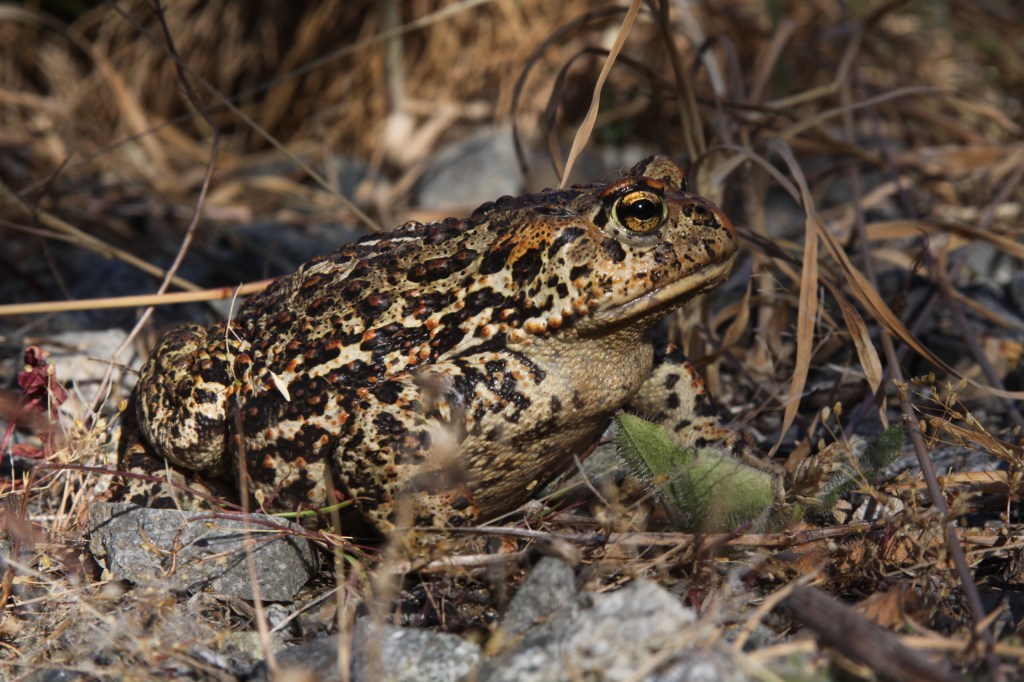
I am going to make my way to Dugualla Lake tomorrow (Saturday, May 8) to check these out Ron. My guess though is that they are not river otter dens, as our river otters typically do not dig dens in this area but rather exploit snags, beaver lodges (even though there are no rivers on Whidbey given it is an Island, there are still beaver), and overhangs, especially if they are near freshwater. I cannot be sure though, as Eurasian otters and riparian habitat river otter (most of Whidbey river otter are marine and freshwater foraging) will dig dens. Just seems likely here. That said, they do exploit tadpoles and have been known to eat salamander when the surf is too rough to fish for their favored food, flounder and sculpin (at least on Whidbey).
Tuesday April 20, 2021 – Mutiny Bay, Freeland, Marcie Hedman
Marcie emailed while kayaking in Mutiny Bay that she observed otters mating along the shoreline. She included a video she captured on her iPhone.
Saturday April 17, 19:00 – Admiral’s Lake, Coupeville, Sarah Blake and Bill Blake wrote:
Bill and I were walking the dog last night just before 7 p.m. and saw a good-sized otter running towards the beach in the double vacant lot area by 205 Keystone.
Friday April 16, 2021, 16:30 – Admiral’s Lake, Coupeville, David Dorsett and Susan Schmidt wrote:
We observed two otters “fighting” across the lake near the small park. Their calls sounded like a raspy baby cry and were definitely angry. it seemed to be over who could be on land or could be in the water. About 7:30 PM I went out on the back deck and realized they were still arguing. I drove to the park and approached the area hoping to get a video and to record the vocalizations. I am texting the video as to what happened next. In the end one of otters swam across to the other side of the lake ending the confrontation.
This morning at 6 AM we observed an otter in the water at the edge of our property apparently feeding. It moved back and forth appearing to blow bubbles and vibrating its body. Occasionally when its head came out of the water it seemed to be chewing something. This went on for over half an hour.
David – you are definitely observing mating behavior in both videos. You also appeared to be a “safe place” for the female during her escape. Mating behavior is typically preceded by aggressive play, or if she is less receptive, just plain aggression. The male grasps her neck in his jaws prior to intromission, the coupling typically lasts from 10 to 40 minutes. The courtship can be quite loud, like you are hearing in your initial video. The behavior of lunging, rolling, and frequent dives is also indicative of courtship. Lucky you, it is not uncommon to hear otters mating (they sound like fighting cats), but it is rare to observe them mating since coupling typically in the water!
Monday April 12, 2021, 15:00 – Scatchet Head, Clinton, Lori Reiter
Lori emailed reporting a lone otter along the road in Clinton.
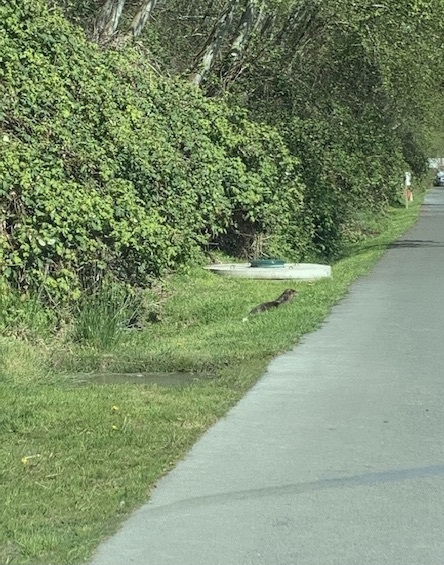
Saturday April 10, 2021, 16:30 – Admiral’s Lake, Coupeville, Jill Cooper
Why did the otter cross the road?
To shoot hoops of course (there is a basketball court just to the right of this video).
Thursday April 1, 2021 – Scatchet Head beach, Jill Lipoti
Jill observed this otter in her backyard and also on Scatchet Head Beach enjoying the Catch-of-the-Day, Starry Flounder.

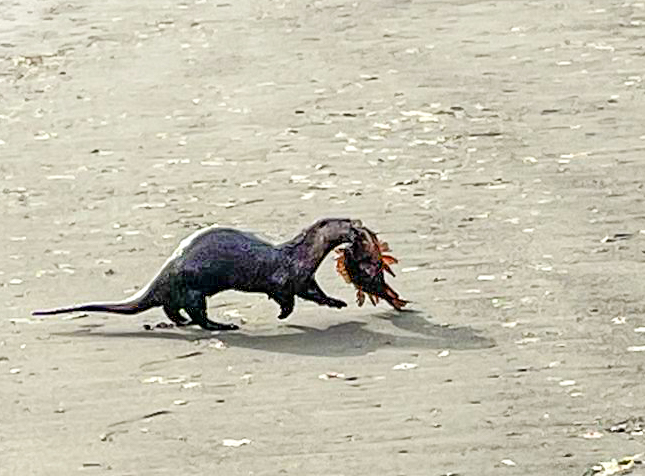
Wednesday March 31, 2021 at 11:52 – Admiral’s Lake, Coupeville, Bob Wilbur
Bob wrote, just to the left of the tide gate, that little blob turns out to be an otter. He’s been showing off there for the past week or more. Was very curious and wanting to make friends with Woebegone (Chesapeake Bay Retriever).

Wednesday March 3, 2021 8:00, Camano Island – Art Moxley
Big thank you Art and Mary for collecting and sourcing storage for this Camano river otter salvage. They found it beside the road. Also thank you to Camano Veterinary Clinic for storing it for me until I could come up and collect her. I was able to honor her death in the best way I can, her data (liver and tissue samples) will be included in an endocrine sample for comparison with the Oregon Zoo. All my salvages are permitted through the Washington State Department Fish and Wildlife.

Wednesday February 17, 2021, Admiral’s Lake, Coupeville – Kurt Blankenship
Kurt and his daughter observed this otter back in February near the tide gate at Admiral’s Lake.
Tuesday, February 16, 2021, 17:00 – Ediz Hook also 13:00 Discovery Trail, Port Angeles,
Alex Patia wrote, I am an active birder in Port Angeles and at least once a week I go out to Ediz Hook and see river otters almost every time. Late summer to fall of 2020 I saw one adult and two pups frequently, including on August 10th when I saw all three up close grooming and scent marking on the beach. It was sunny, 60 degrees F and the otters were on the bay side of the hook close to the paper mill. This winter I have seen just two otters, most recently on 2/16/21 at Ediz Hook. It was partly cloudy, windy, and 45 degrees F. They were both on the floating log boom, one was sleeping and the other was eating a flounder, this was around 4:40-5 pm.I also saw a lone river otter on the Discovery Trail on the Port Angeles waterfront about a mile west of the Morse Creek trailhead on 2/16/21. There was a lot of otter scat at these coordinates (48.1152, -123.3616) so presumably a latrine, and around 1 pm we saw the river otter cross the trail going from the beach up the hill into dense understory. It was overcast, windy, and 45 degrees F then. It was interesting to see it headed uphill so far away from the water, far too early for denning, maybe another latrine?
Wednesday February 3, 2021, 12:00 – Penn Cove, Coupeville, Ed Delahanty wrote,
On separate occasions both Carol, my wife ,and our daughter, Anna have seen what we believe to be a river otter in Penn cove, floating on its back. Both sightings probably occurred around noon, from a car on Hwy 20, relatively calm days.
Trail Camera Captures Red Lynx along Baker Creek, Oregon

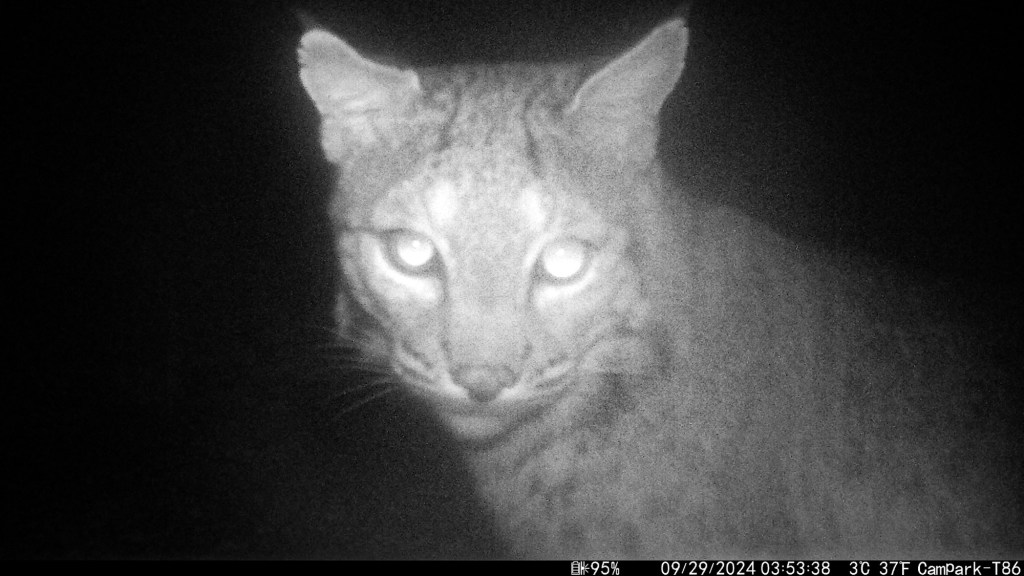
In the middle of the pandemic and social distancing this summer, Tom, the two dogs, and I moved from Portland to farm property along Baker Creek in McMinnville. A move that increased my drive time in weekend travels to Whidbey Island, but on my McMinnville-to-Forest Grove commute, it is considerably shorter and within the embrace of the beautiful, Willamette Valley. Since our move, I have installed 6 trail cameras along the acreage. Most of which, consists of fallow fields of thistle, sedges, grasses, and hardwoods along native, riparian habitat of Baker Creek (albeit some invasive species that need extricating). I first caught this footage of a red lynx along the property back in September. But it was a ghost, slinking past the lens in the night fog, just a 3-second glimpse, revealing nothing but long, sturdy legs up to a slight waggle of the inked-tipped bobtail. In late October, I captured this footage of the lynx (bobcats are actually red lynx) hunting moles and screen captured one of the video frames to showcase its ruff and gorgeous face. Below is the video footage. The date is wrong, it reflects my failure to reset the date and time (filmed using a new CamPark camera). Enjoy! They are a delight to watch.
Babes on the Beach: It’s Harbor Seal Pupping Season in the Salish Sea
In the summer of 1995, I was involved in a summer internship with Beth Mathews, a Marine Biologist and just a stellar human being, through the University of Alaska Southeast. We were conducting harbor seal cow-pup counts in Glacier Bay, at John Hopkins Inlet. I fell in love with animal behavior many times during my life, but that was one of the first times I realized how much there was to learn from individual animals, not just whole taxonomic groups.
A harbor seal pup, pulled those Glacier Bay memories back to the fore of my memory this week. It is pupping season in the Pacific Northwest, the time of year when those sausage-shaped pups with bowling-ball faces haul out on beaches to await mom to return from feeding to nurse. The cow’s milk is about 80% fat, it is so rich that the pups are weaned after about a month to fend for themselves. Although Harbor seals are protected by the Marine Mammal Protection Act (you cannot approach a seal or seal pup), they are the most common marine mammal in the Salish Sea. Despite this, according to Gary Heinrick of the ORCA Network, about 50% of the pups die in a given year. This brings me to the topic of this post, I received several emails from folks around the island with photos of dead seal pups and inquiries about the local otters, were the otters okay?
The otters on the island are doing well, there is mortality every season for all animals, some due to human disturbance, some due to climate changes, pollution, predation, and others…well, they just get old. Gary Heinrick indicated that last week there were several Biggs Orca (transient orcas – mammal eaters) sightings near Coupeville. Spotters reported harbor seal predation during these sightings.
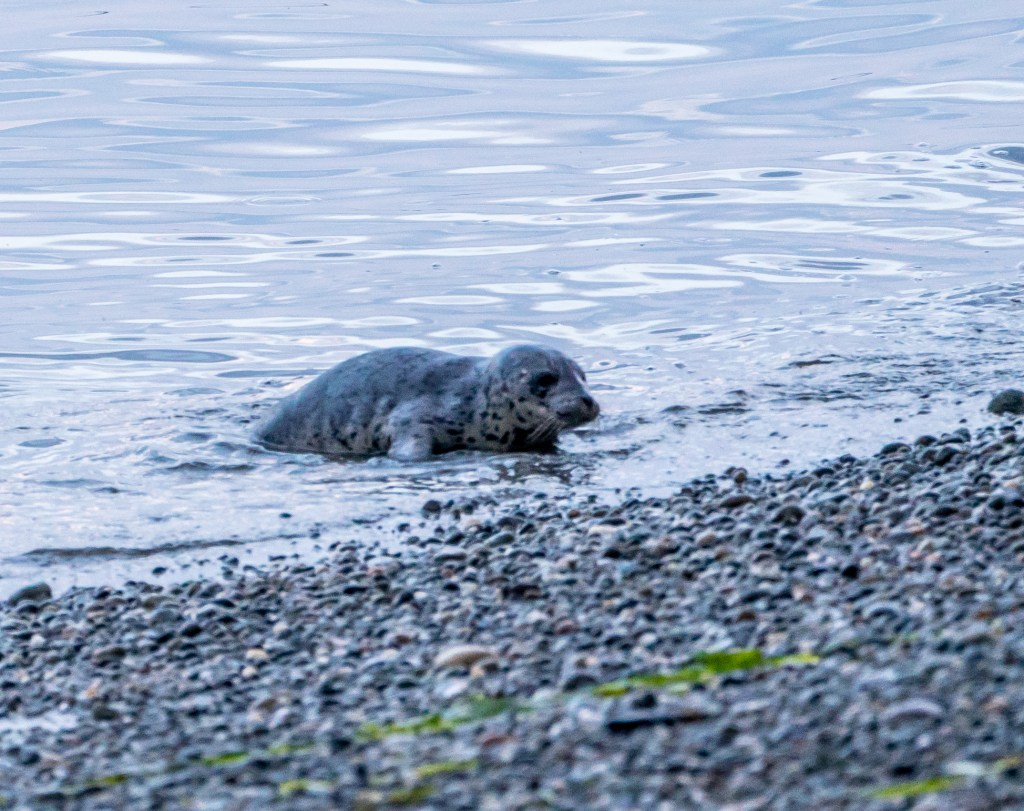
On Saturday an ocean-front neighbor from one of the high bank homes spotted a harbor seal pup in the intertidal zone and called me to see if it was okay. I walked down the beach, snapped a video with the zoom and sent it to the ORCA Network, who has a group of marine mammal stranding supporters. Here is that video.
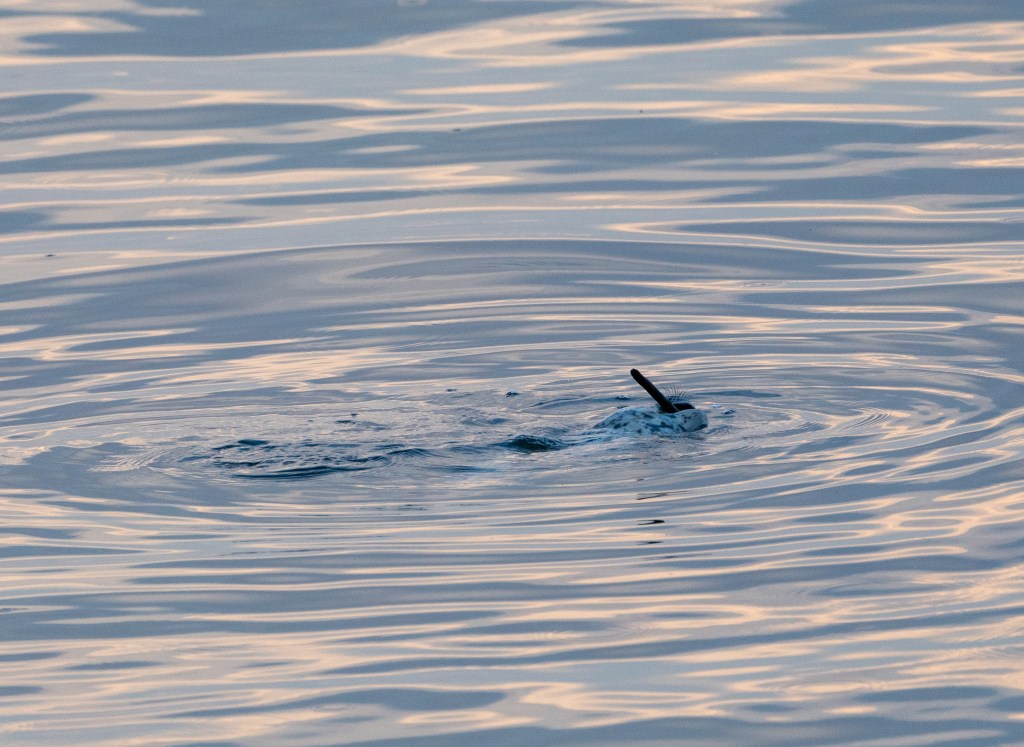
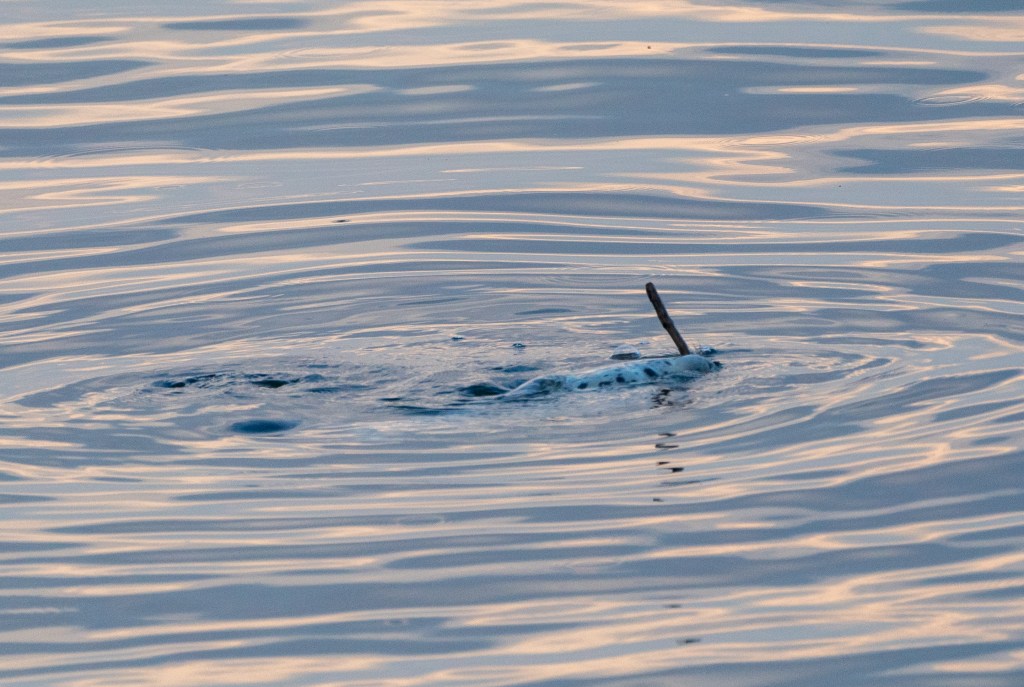
The pup was not distressed, but did look a little emaciated. From 9:30 in the morning until 3:00 in the afternoon the pup sunned himself and then returned to the bay muling for the cow. The next morning, during my otter scans at 4:30, I heard the pup muling in the bay; but did not see it until about 5:30 when twilight broke. The pup was still alone. The pup shrugged its way up the beach to rest, then returned to about 60 meters from the beach and proceeded to play with a stick for about an hour. We cannot know if the little fella made it, but here are some photo shots of the observations.




When River Otters Chuckle and Raccoons Chitter
July has been an exciting month for otter sightings, indeed for all wildlife on the Island. Patches was seen in Admiralty Bay with two new pups, likely spring births.


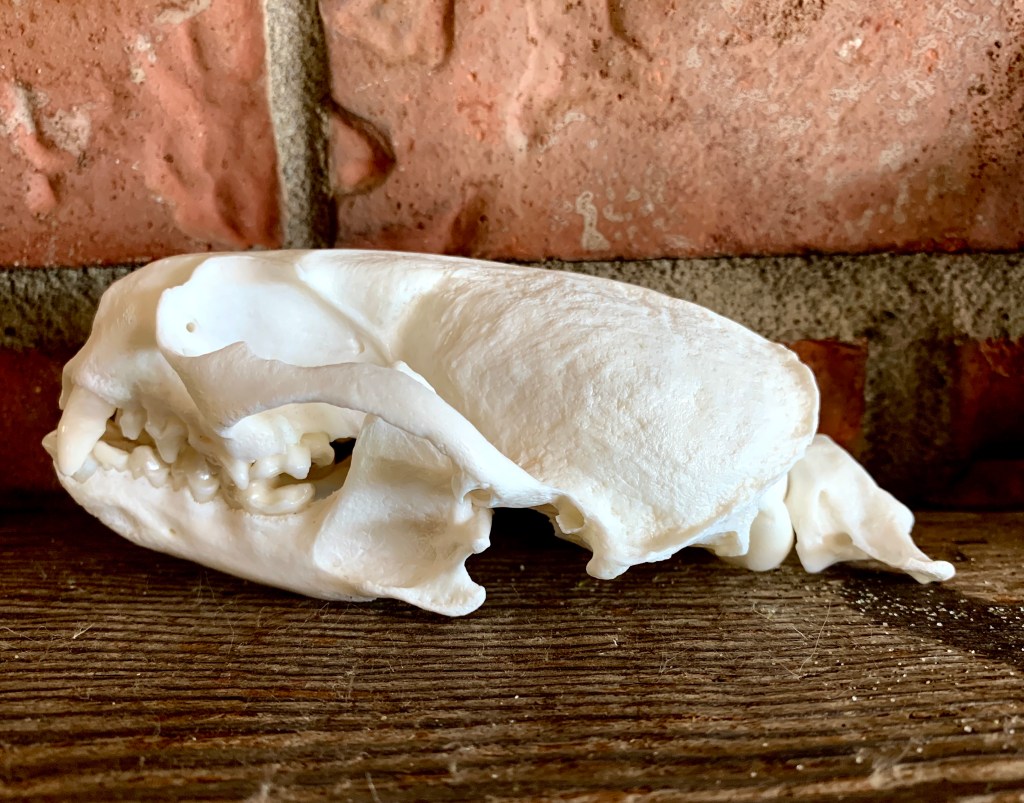
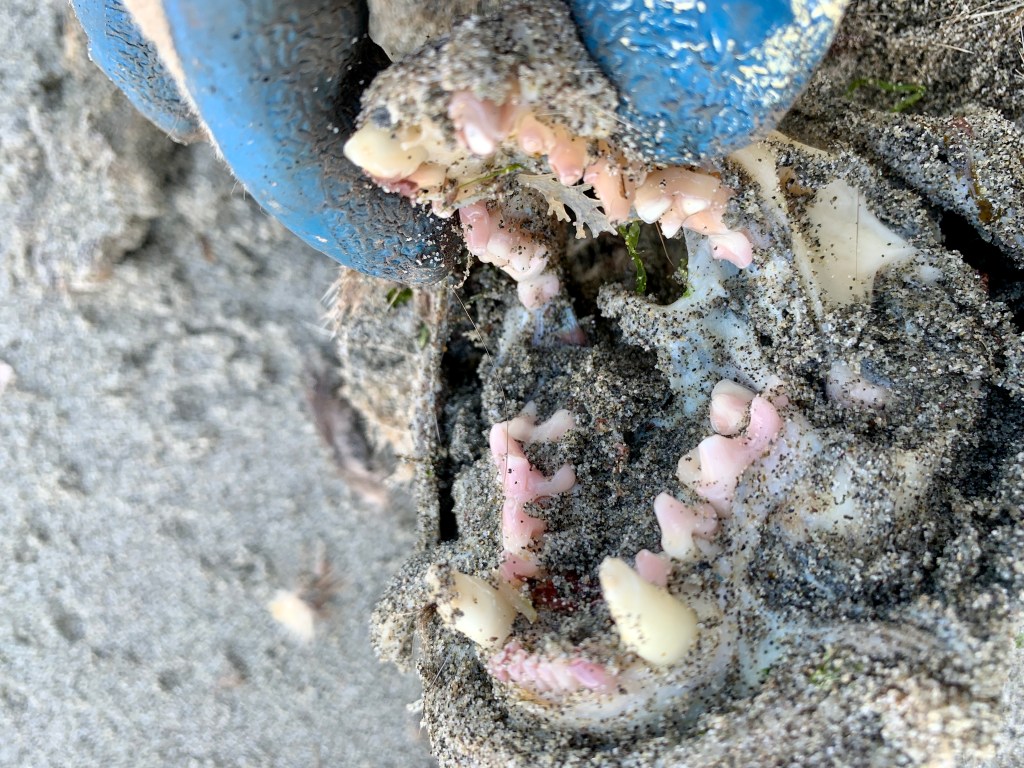
While a small female (unidentified) was found dead at Teronda West, just before the Fourth of July. Below is a photo taken within 24 hours post-mortem by Amanda Ford, a local resident and otter enthusiast, as well as a photo I took two days later when I was able to examine the carcass. The cause of death appeared to be from a wound to her throat, likely from a territorial conflict. Her body length from crown to tail was 49 inches, and her teeth had very little wear, likely only a year old. I salvaged the skull and the vertebral atlas (permit #Island19-282) and cleaned them using the State of Alaska’s Fish and Game salvage protocols (Note the dentary of the lower jaw are two separate bones and detach when the tissue is boiled off, thus requires glueing for an intact jaw). The skull will be a provided as an educational resource in my animal behavior course and in wildlife presentations.

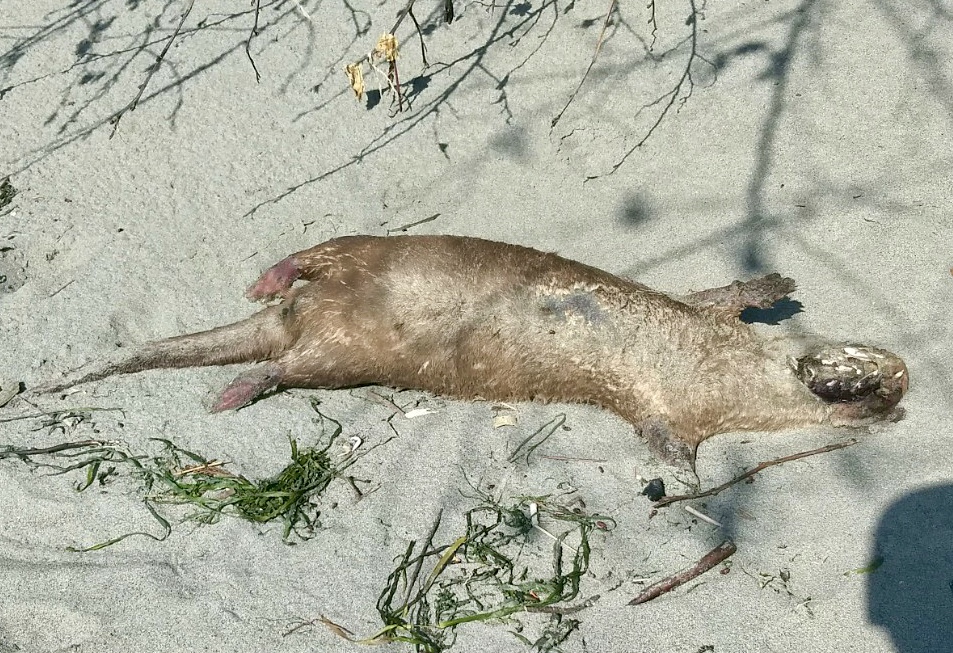
Despite the discovery of the otter at Teronda West, I have received many reports across Whidbey from residents enjoying sightings of kinship groups as well as lone otters foraging in the intertidal areas. Below is a video of a kin group at Lake Pondilla, note the audible “chuckling.” River otters have a vocal repertoire of about 12 different vocalizations, the “chuckle” has been described as sounding like a grunt, snort, or purr.
Similarly, a raccoon sow and her three kits were also captured at Lake Pondilla via my infrared camera (permitted through Fort Ebey State Park, permit# 190801). You can hear the sow and her kits volley chitters back and forth as she attempts to coax them across a log. Bravo to mom for her extra vigilance – you will see her repeatedly monitoring the bank, that is because that area faces the hiking trail.
Along Admirals Lake in the Admirals Cove community, a beaver and coyote crossed paths within minutes of one another – note the coyote was fearful of the “evil red eye” of the infrared light on the camera (I need to get a different model – there are some that do not have such an overt light).
It has been a great month for wildlife.
Also, totally unrelated, but a great part of my week…thank you to Tony and Lindsay Blackner, who have been mentoring me in the fine art of beekeeping. Below is a photo of their hives and the “girls.”

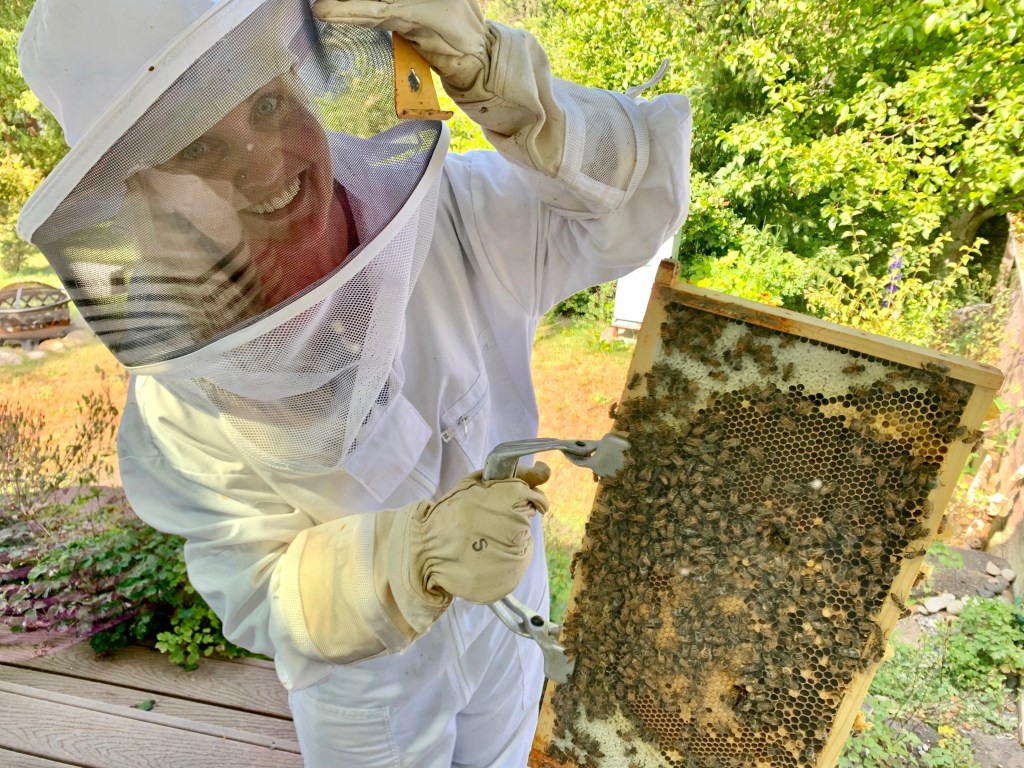
Finally, a big “thank you” to Amanda Ford, Sarah Schmidt, Jann Ledbetter, Janet Johnston, and Jill Cooper for their sightings and reports this month!
Salmon Season for Admiralty Bay Eagles
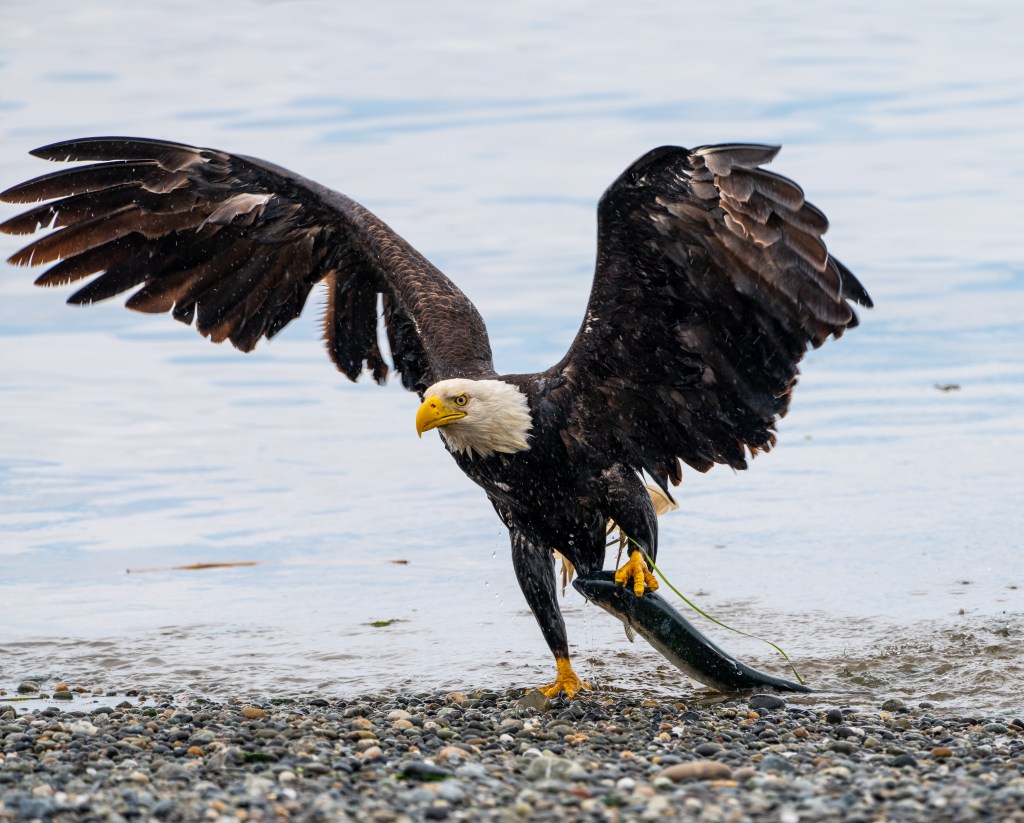
I observed this bald eagle fishing in Admiralty Bay on June 24, 2020 from 11:20 am through 11:30-ish. That is how long it took for it to circle above the bay to identify the salmon in the water, plunge rather unceremoniously into the salt water, swim about 60 meters from the bay to the shoreline, preen its feathers, adjust her grip on the salmon, and take off to the nest by Admirals Lake. This is the third time I’ve observed eagles fishing in Admiralty Bay this season. I took over 100 photos of this observation event, but here are the highlights.




Whidbey Citizen Scientists Capture Rare Footage

Mating Season on Whidbey is typically in April and May (give or take a month). These two amorous otters were observed by Jill Lipoti off Scatchet Head beach on the southernmost tip of Whidbey Island.
One of my trophy cameras situated near a den site on Lake Pondilla, Fort Ebey State Park also captured mating otters this May, though the footage is not nearly as good as Jill’s.
Though river otters typically mate in the water, courtship occurs throughout the day for several days. “Dinner and a movie,” may occur under residential decks. Be mindful, as limerence can sound more like fighting raccoons, with hissing, snarling and growling. Rest assured, this is part of the courtship process and if they found a love nest in your yard, they do not typically stay there for more than a day or two.
This exciting video of two coyotes (one on either side of the shrubbery) and a lone otter was captured by Kevin Shambaugh along Kennedy Lagoon in Coupeville. It is hard to know from such a brief video what is going on, it could be play, or what I think is perhaps more probable is den site guarding. Although the coyotes’ posture does not necessarily appear aggressive, coyotes mate in February to April with a gestation of approximately 60 days. Litters typically consist of 4 to 5 pups. Conversely, the otter may be a female trying to gain access to her own den site. It is difficult to know for certain; though the footage is wonderful. Thank you Kevin Shambaugh and Sue Sell for sharing!
If you have footage you would like to share of local wildlife, please email me with permissions to share your wonderful nature experiences, island@pacificu.edu
No Shelter in Place for Whidbey Otters
www.instagram.com/p/B-s3QtAFudv/
This video was taken by local Photographer Extraordinaire, Jann Ledbetter while out for a kayak in our beautiful sunny week.
Wilderness Recovery in the Time of Corona
With global quarantines, stay-at-home orders, and less industry, wildlife are taking back the suddenly vacant urban spaces across the globe. Here is great article in The Guardian about how this small respite in human activity has bolstered wildlife (Singapore’s Small clawed otters), water quality (Venice canals), residential deer, coyotes, raccoons, etc.
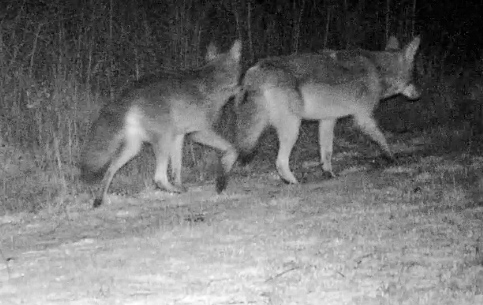
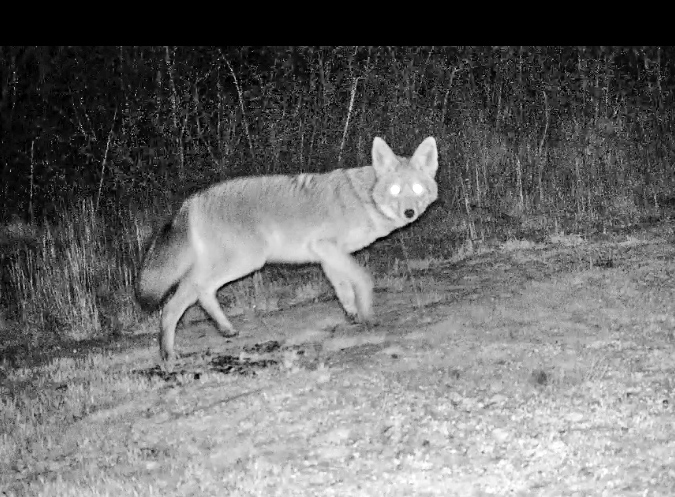
On Whidbey, the coyotes are just ending their breeding season, as such, they have starred in all the infrared camera activity. The otters typically stop or slow down their latrine activity during this time, from January through April.
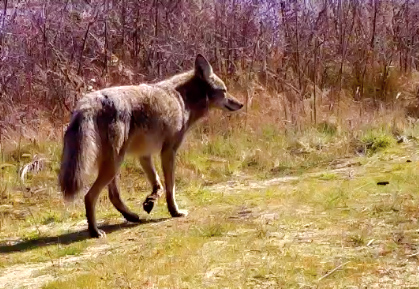
All photos from March 2020
Warmest Wishes in the New Year!
A Christmas Surf Scoter
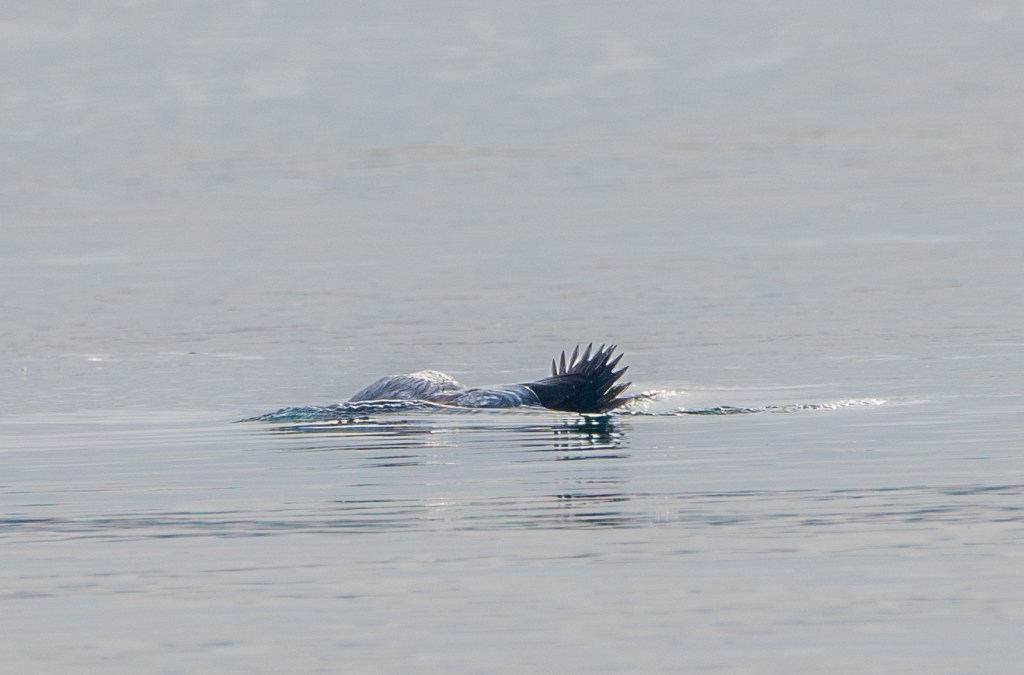
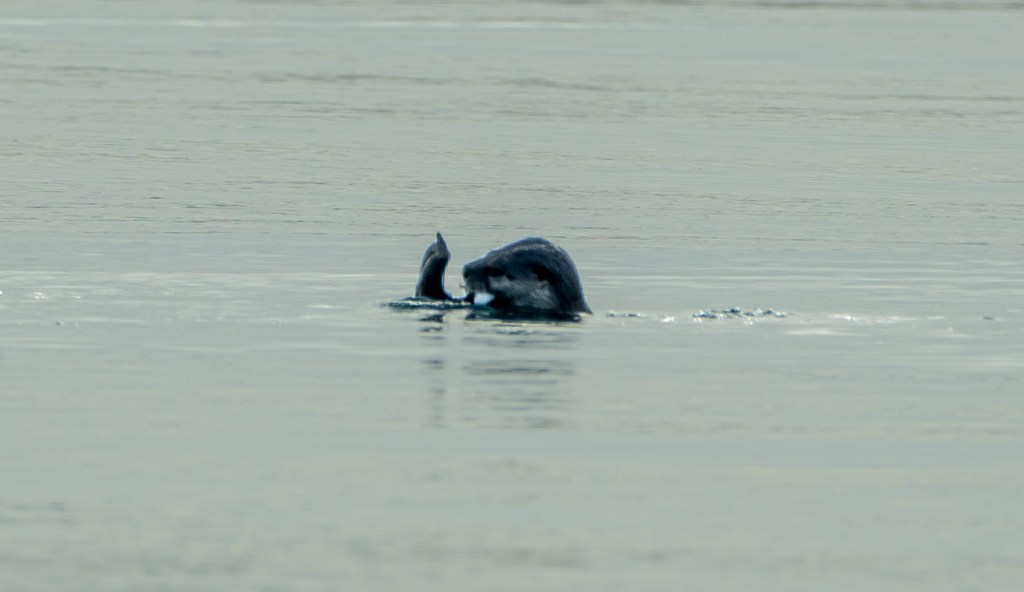
It is the new year and as if to provide one last “hoorah for 2019,” on December 25, a lone otter caught a Christmas Surf Scoter for breakfast in Admiralty Bay. The images below are not exceptional given the low light, but you can see the wing, part of the head, and the bright orange feet in the images. Note there is a drake surf scoter looking on, rather unperturbed during the hunting sequence.




River Otter Diet Data – Research Phase 1: Completed (December, 2019) and To Be Presented (February, 2020)
The last of the diet data was completed in December of 2019. The samples are drying for analysis through Pacific Identifications for a final interpretation of our Whidbey Island river otters’ seasonal foraging and diet preferences across the island. This data comes from latrines as far north as Strawberry Point to as far south as Clinton, as well as Lake Pondilla, Crockett Lake, Admiralty Bay, Admirals Lake, Bush Point, Mutiny Bay, Greenbank Farm, and Deer Lagoon. I will discuss the findings of phase 1 of this project, Density, Distribution, and Diet of Whidbey Island’s River Otters at the Sound Waters University Conference, Saturday, February 1, 2020 in Langley. Here is a link to that exceptional community of conservationists, scientists, and educators – Sound Water Stewards Conference. Among the 60 different classes and presentations during this conference, Sarah Schmidt will be presenting her work with Whidbey Island bats, Dr. Greg Jensen, will discuss his research of Salish Sea marine invertebrates, and Dr. John Calambokidis of Cascadia Research provides the keynote address, Changes in Large Whales of the Salish Sea and Recent Mortality and Threats. Register here.
Ever Grateful to You, Otter Spotter Supporters
Special thanks to Pam Stein, Jan and Karl Smith, Jill Cooper, Bob Wilbur, Cathy Miller, Rebecca Jaffe, Janet Johnston, and Jeanine Granstrom for their recent river otter reports, and support.
Have a Joyful, Successful and Healthy 2020!
Whidbey Island Research Station (WIRS) Updates

Patches is back!
This is an image capture from an infrared video along a den site at Admiralty Beach on November 27, 2019 at 2:35 am. She is traveling to Admiralty Bay to feed in a romp of 3 other otters. Although she has not been “missing,” her last confirmed citing was in August of 2019.

Muzzle markings provide identifications…
Patches in May of 2019 (in estrus), notice the two distinct spots under each nostril in both photos.
Appreciation and Project Updates
A friend suggested a blog in place of a newsletter, as it is a more contemporary, paperless approach to sharing information and updates. It also allows you to control your updates and membership. So, welcome to the WIRS first blog post! This one will be longer given I have a lot to report, subsequent blogs will be much shorter. Also please let me know if you would like more information about something specific.
Appreciation: A quick shout-out to Jan and Karl Smith (Bush Point), Susan Carpenter (Bells Beach), Pam Stein (Strawberry Point), Barb Nichols, Bob Wilbur, and Kurt Blankenship (Admirals Cove), Janet Johnson (Goss Lake), Doug Clark (Clinton), and Sherri Hedman (Freeland) for their correspondence of otter presence, scat collections, and/or infrared video placement on their property. Also a big thank you as always to the folks at the Whidbey Camano Land Trust and Whidbey Environmental Action Network, I am so grateful for your support.
Research Update: The Whidbey Island River Otter Research project is in the second year of data collection. We have one month left to collect diet data. If you would like a quick introduction to the defined goals of the WIRS river otter research, please click the link here for a summary. Below is a graph-to-date of the prey diversity of the Whidbey river otter populations across the island.

Grant funding has also begun. A smaller grant was sent off this week for the genetic fingerprinting protocols – that is, through scat collection we hope to run genetic fingerprints (like you see on CSI) to identify individual otters across the Island. This is the most benign, nonintrusive approach to clarify population range and foraging distribution. A second larger grant proposal will (hopefully) be submitted by the end of spring for scat analysis of endocrine disrupting chemicals, including brominated flame retardants (see Seattle Times 2017 for information on Whidbey Island watershed contamination), stress hormones, and parasitology. We also hope to include students in summer research at WIRS.
Scat Collection and Otter Spotting Volunteers Needed!
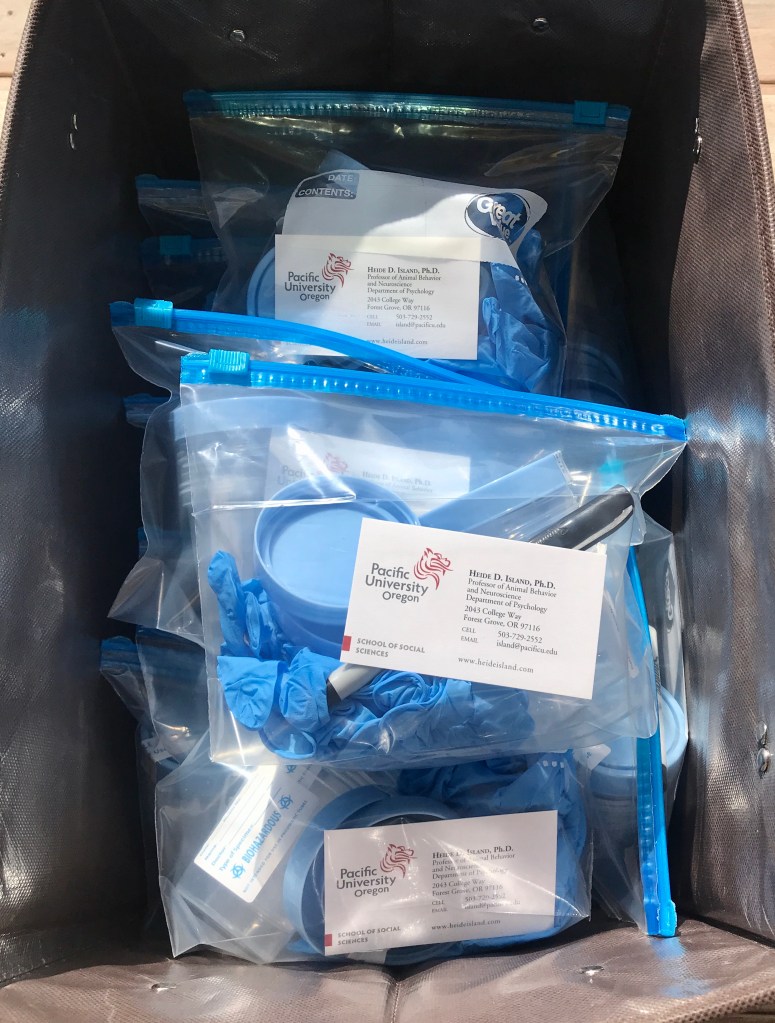
If you have otters in your area, please report them to the WIRS Citizen Scientist Otter Reporting Website here (you can also find the Citizen Scientist Otter Reporting link on the Home page). For the truly industrious and committed, I have specimen collection kits prepared for those who have active latrines along their property. Please contact me if you would like one, I will deliver it to you! I am on Island from December through the end of January. Further, if you have “problem” river otters occupying your decks, boats, or boathouses, please do not hesitate to contact me, I am interested in finding a solution for you and the otters. I would also be happy to plant an infrared camera in locations of heavy otter traffic – I share all images with the property owner.
Holiday Shopping?
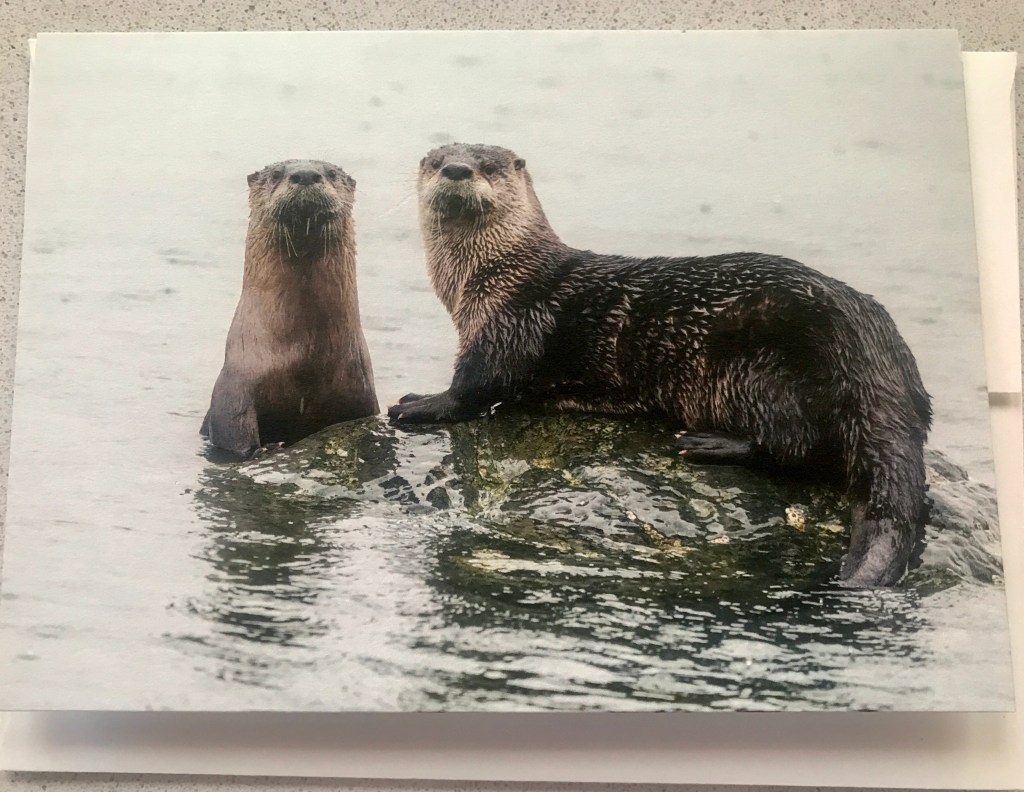
How about river otter greeting cards for the holidays? WIRS river otter cards (two different image options) are for sale at the Langley Whale Center. All proceeds for the sale of the WIRS cards go to benefit whale conservation.

 Heide Island, Ph.D.