I LIVE for the “what the hell is that?” moments. Those moments in the field or in the lab that catch me by surprise and drive the direction of my science. Coupled with a broad background in zoology and the behavioral sciences (I teach in both the psychology and biology departments), they have led me down an unusually wide range of research paths.
One such “what the hell?” moment involved an orphaned sea otter and her foster mom. Juno was found orphaned along the California coast in 2014 when she was estimated to be only about a month old. Later that year, she arrived at the Oregon Zoo, where she was introduced to Thelma, an adult female who immediately adopted her. Like any sea otter pup, Juno began to suckle. Thelma, however, had a deslorelin contraceptive implant and produced no milk. Yet she allowed Juno to continue nursing.
Juno seemed to know the tap was dry. She repeatedly “sipped the air” in a behavior called the flehmen response, something commonly observed in cats, horses, and even hippopotamuses, but not among sea otters. What the hell? During a flehmen response, an animal curls back its upper lip, wrinkles its nose, and pauses with its mouth slightly open, drawing odor molecules toward the vomeronasal organ, a specialized sensory structure in the roof of the mouth that detects chemical information the ordinary sense of smell cannot. Juno appeared to be sampling the air, trying to determine why the milk was not there. That observation had never before been documented in a sea otter.
Science is a method, not a discipline. It is not a single-lane road that forces us to stay on one heading. It is a highway where every unexpected observation offers the possibility of a new destination. The moment an observation is followed by the question, “What the hell is that?” you have taken an off-ramp into the scientific process. From there, you follow the route into the literature, develop or apply a theory, generate a prediction, and then test it. Once that prediction is subjected to rigorous methodology and the resulting data are collected, analyzed, and interpreted, curiosity has become science.
I’m a lifelong student of nature, and I don’t stay in my lane. I’ve published papers in behavioral ecology, psychology, sociology, program evaluation, and gender studies. My current projects focus on the behavior and conservation of North American river otters, sea otters, California sea lions, and Pacific University’s population of western gray squirrels.

Through research, teaching, writing, and community science, I encourage my fellow students of nature to look more closely, ask better questions, and appreciate not only what animals do, why they do it, where those behaviors occur, how they are affected by the environment, but also, how we can better conserve the habitats and ecosystems we share.
I am a professor of Animal Behavior and Neuroscience at Pacific University in Forest Grove, Oregon, and the author of Romp! A Journey Through the Natural History of Otters and Why They Matter. I teach behavioral ecology, behavioral neuroscience, research methods, and related courses in psychology and biology. My students and I spend as much time in the field as we do in the classroom because science is best learned by doing it.


Growing up along the Lynn Canal in Southeast Alaska, I began my wildlife education as a deckhand aboard my dad’s commercial fishing vessel, the F/V Blue Zephyr. Those early experiences led me to study zoology at Washington State University and the University of Alaska Southeast, assisting in research documenting harbor seal cow-calf populations and the effect of the crab fishery on fecundity of Dungeness crab in Glacier Bay. I later worked as a research naturalist for Pacific Whale Foundation on Maui, before earning my master’s and doctorate in Comparative Animal Behavior at the University of Montana in 2003.
Today, my research explores how wildlife responds to changing environments and human activities. My students and I study North American river otters along the shores of Whidbey Island and collaborate with colleagues at the Oregon Zoo, Seattle Aquarium, and Oregon Coast Aquarium to better understand sea otter behavior, welfare, and social dynamics. I also work with Smithsonian scientists through Snapshot USA, a nationwide effort to document the occupancy, distribution, diversity, and relative abundance of mammal populations across the United States. Across these projects, my goal remains the same: to answer those “what the hell?” questions, understand animal behavior in ways that inform conservation, and to inspire stewardship.


Pacific University has been part of my family’s story long before it became part of mine. My maternal aunt, my mother, and my father all attended Pacific. My parents met in Warner Hall, where my mother hosted a radio program called Moonlight Serenade, featuring artists such as Pat Boone, Andy Williams, and Johnny Mathis. My dad’s show, Rock Around the Clock, played The Beach Boys, Little Richard, Chuck Berry, and James Brown. Forty-two years later, I walked into the same room in Warner Hall where they met, remodeled from a recording studio to a classroom. Pacific has become more than the place where I work and the alma mater of my parents. It has grounded my family in place, community, and shared friendships now for over sixty-three years, longer than I have been alive.
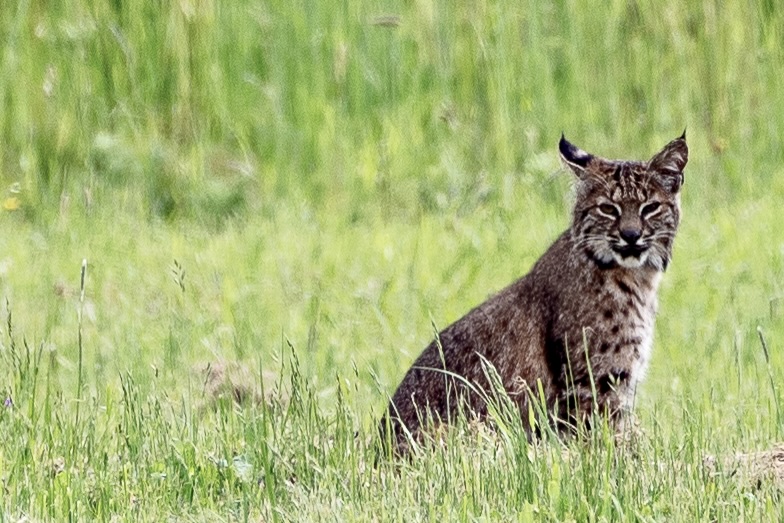
I live just thirty minutes from Pacific in McMinnville, Oregon, on a small homestead in the Willamette Valley. My husband, Tom, and I are restoring habitat along Baker Creek by removing invasive species, encouraging native vegetation, and creating healthier conditions for bobcats, cougars, coyotes, black-tailed deer, owls, opossums, raccoons, pollinators, and countless other species that share this landscape.
In many ways, the farm has become an extension of my classroom, reminding me that meaningful discoveries rarely require traveling far. They begin with careful observation, thoughtful questions, and a willingness to pay attention. Those same ideas shape the research, writing, community science, artwork, advocacy, and stories you’ll find throughout this website.




The photos below are a plug for Ocean Futures, an experience I was privileged to contribute to as part of an Earthwatch service project, alongside Jean-Michel Cousteau, evaluating the health of Fijian coral reefs and the impacts of crown-of-thorns sea stars on coral communities.

