ROEP and VIDEO are linked HERE

LINKS
Water
The importance of water and my statistics are in part from the “Our World in Data: Water Use and Stress” website. Also the characteristics and biochemistry, the “specialness of water” largely comes from this peer-reviewed article, Frenkel-Pinter M, Rajaei V, Glass JB, Hud NV, Williams LD. Water and Life: The Medium is the Message. J Mol Evol. 2021 Feb;89(1-2):2-11. doi: 10.1007/s00239-020-09978-6. Epub 2021 Jan 11. PMID: 33427903; PMCID: PMC7884305.
The PDF of the Federal Water Pollution Control Act, 1948 (“Clean Water Act,” 1972) with Amendments up to 2018 and the PDF of the Safe Drinking Water Act, 1974, which “established protective drinking water standards for more than 90 contaminants, including drinking water regulations issued since the 1996 amendments to the Safe Drinking Water Act that strengthen public health protection.” Here is the weblink to the summary of the legislation.
The Environmental Protection Agency Website – Very useful for definitions and terms for what a clean watershed looks like, how watershed health is measured (e.g., The Healthy Watershed Index), and how some waters are vulnerable (e.g., Watershed Vulnerability Index)
Pollutants
PFAS chemicals, which is an umbrella term for PFOA, PFOS and other synthetica, industrial “forever chemicals,” and stand for “per- and polyfluoroalkyl substances.” A description of the differences and their health consequences can be found at the American Cancer Society, linked here to PFOA, PFOS, and Related PFAS Chemicals.
Some states are at greater PFAS contamination risk than others, the Environmental Working Group, is a nonprofit research and advocacy organization, published a report in 2020 stating that an “estimated more than 200 million Americans are served by water systems where two of the most studied PFAS chemicals (umbrella category of these synethic chemicals): Perfluorooctanoic acid (PFOA, pronounced: per-FLOOR-oh OCK-tan-OH-ick acid) and perfluorooctane sulfonate(PFOS) – were present in drinking water at a concentration of 1 part per trillion, or ppt, or higher.
Here is their map of PFAS contamination in the U.S. by state.
Additionally, here is an interactive map developed in support of veterans, a population disproportionately affected by exposure (full disclosure: developed by a law firm that helps veterans navigate disability benefits) that shows contamination risks across U.S. military bases.
Plastics. As of the time of this post, global annual plastic production is approximately 450 million metric tons. Our World in Data, provides a breakdown. NOTE: I use this source a lot. It’s an organization that, through the collaborative efforts of researchers at the University of Oxford and the Global Change Data Lab, provides an up-to-date statistical record of meaningful statistics (like Pew Research).
Microplastics: The long legacy left behind by plastic pollution. UN Environment Programme
The life of microplastic: how fragments move through plants, insects, animals – and you. Phoebe Weston and Tess McClure, July 28, 2025, The Guardian
Pharmaceuticals
Bean, T. G., Chadwick, E. A., Herrero‐Villar, M., Mateo, R., Naidoo, V., & Rattner, B. A. (2024). Do pharmaceuticals in the environment pose a risk to wildlife? Environmental Toxicology and Chemistry, 43(3), 595-610.
Fabbri, E., & Franzellitti, S. (2016). Human pharmaceuticals in the marine environment: focus on exposure and biological effects in animal species. Environmental toxicology and chemistry, 35(4), 799-812.
Norman, S. A., Lambourn, D. M., Huggins, J. L., Gaydos, J. K., Dubpernell, S., Berta, S., … & Scott, A. (2021, January). Antibiotic resistance of bacteria in two marine mammal species, harbor seals and harbor porpoises, living in an urban marine ecosystem, the Salish Sea, Washington State, USA. In Oceans (Vol. 2, No. 1, pp. 86-104). MDPI.
Ojemaye, C. Y., & Petrik, L. (2019). Pharmaceuticals in the marine environment: a review. Environmental Reviews, 27(2), 151-165.
Ecological Terms
The role of particular flora or fauna in ecology that are considered “Keystone,” “Indicator,” “Priority,” “Flagship, or “Umbrella” species are explained through the World Wildlife Fund (WWF, 1961) or World Wide Fund for Nature (name change in 1986) on their Global Species Programe webpage.
The late, great Dr. Robert (Bob) Paine’s 1966 Paper, “Food Web Complexity and Species Diversity” is available HERE, as well as a great biography about him and his work on the keystone predator concept through starfish research, HERE. A memorial article, penned by Jim Estes and his colleagues, is linked here, titled “A keystone ecologist: Robert Treat Paine, 1933–2016.”
Similarly, the late, great Dr. James (Jim) A. Estes (Researchgate link), the sea otter ecologist and one of the first Otter Specialist Group members through the IUCN, was the first to apply the keystone concept to sea otters and their importance in the trophic equilibrium of kelp forests. The keystone sea otter manages the herbivory of the sea urchins, preventing urchin barrens, places where kelp was once abundant, but through urchin overgrazing, transform into barren deserts. Estes’ original 1974 paper, “Sea Otters: Their Role in Structuring Nearshore Communities,” can be found HERE.
There are also two wonderful tributes to his work, one through the Elakha Alliance (Oregon) and Sea Otter Savvy (California).
PBS Nature, has a great documentary, called “The Serengeti Rule,” a film that highlights the careers of these two accomplished ecologists, Bob Paine and Jim Estes. The film is linked HERE. Bob discusses his work in understanding the role of sea star predators in the ecological system, as well as Jim Estes and the importance of trophic cascades. The latter is illustrated through the collapse of some populations of Northern sea otters in Alaska. Their collapse was the result of a ripple effect triggered by decades of whaling. The removal of the gray whales caused a dramatic decline in a primary food source for mammal-eating killer whales, who took to eating harbor seals, then Stellar sea lions, and sea otters, such that by the end of the 1980s, there were places where sea otter populations had been wholly wiped out from orca predation. This resulted, then, in the collapse of the kelp forests around areas that were once flourishing.
Here is podcast episode #30 through Northwest Nature Matters, with Jim Estes
Ethical Guidelines for Wildlife Photography and Social Media
Practicing Ethical Wildlife Photography. Canadian Geographic
Ethical Guidelines for Wildlife Photography. League of International Photographers
What does it mean to be an ethical wildlife photographer? Sea Otter Savvy
Decision Tree Flow for Sharing or Promoting (i.e., Likes) Animal Photos on Social Media, Share Savvy
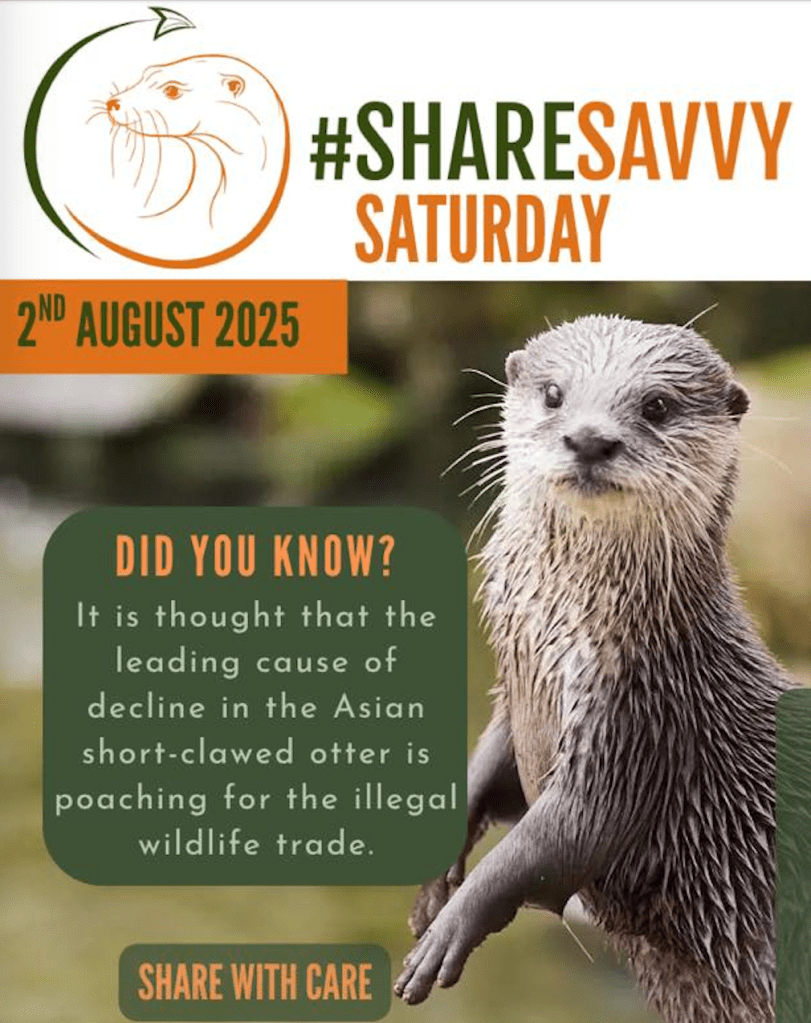
This advocacy organization offers suggestions for key considerations in identifying and promoting ethical animal photographs. The reason this matters is that there are a number of species, many endangered like the Asian small-clawed otter, that are targets of the illegal and exotic pet trades. Many of the videos and photos that are popular on Facebook, TikTok, and Instagram are not from reputable sources and are of wild animals that have been adopted as pets. This is an area of concern covered in my upcoming book, “Romp! A natural history of otters and why they matter.” Release date: May 2026.
Ethics of Wildlife Photography. The Wildlife Collective
“We Sure Could Use A Little Good News Today”…
Scientists find bioplastic that vanishes 80% even in extreme deep-sea conditions, Kaif Shaikh, July 23, 2025, Interesting Engineering
Scientists create ultra-repellent non-stick coating for safer cooking at home. Amir Khollam, July 25, 2025, Interesting Engineering.
Technology for the Greater Good. “Top 10 Conservation Technologies of 2025.” Matthew Miller, Cool Green Science: Stories of the Nature Conservancy.
How scientists are using facial-recognition AI to track humpback whales. Lauren Sommer. February, NPR
Happy Whale, Online Catalog for the Reporting and Identification of Humpback Whales
Natural Plant Extract Removes up to 90% of Microplastics from Water. SciTechDaily, June 18, 2025
 Heide Island, Ph.D.